

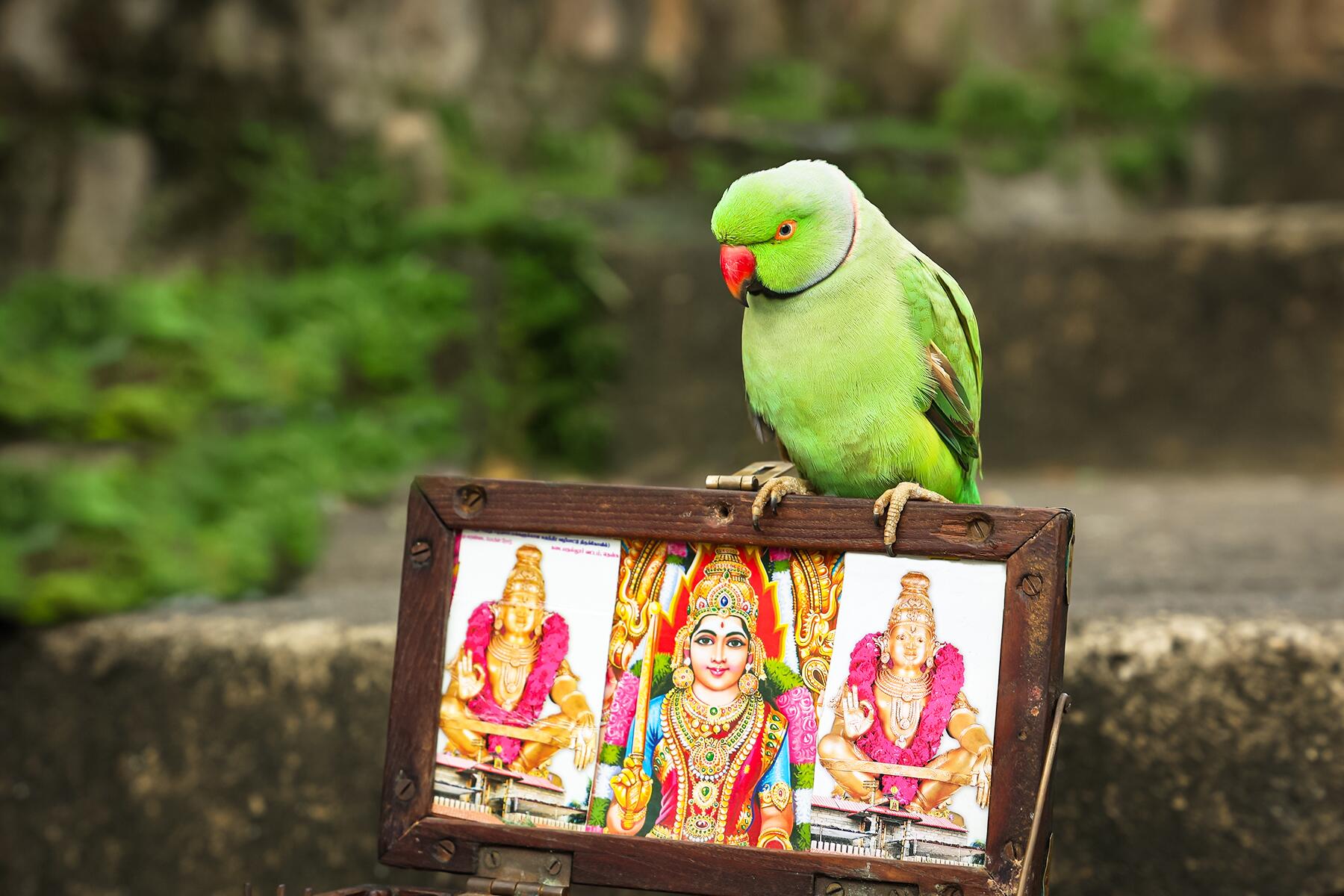
In Tamil Nadu, a trained parakeet reveals fortunes through sacred cards.
I’m sitting in the shade of a thinnai, a traditional raised veranda found in front of entrances to homes in the South Indian Tamil Nadu state. Beside me is Dhamodaran, a 75-year-old fortune teller from the village of Kanadukathan with a sear of holy ash on his forehead and Meenakshi, a green rose-ringed parakeet.
Dhamodaran lets Meenakshi out of her portable wooden cage and begins murmuring to her, motioning her over to a stack of Tarot-like cards. She begins pulling ones off the top with her beak. At the fifth, she pauses, cocks her head, and passes it over to Dhamodaran, who rewards her with a few seeds.
Dhamodaran and Meenakshi practice parrot astrology (“Kili josyam” in the Tamil language), which was once the prevalent method of learning one’s future across Tamil Nadu. People often consulted these clairvoyants for answers to specific questions, like when a relative would recover from an illness, or to gauge romantic compatibility with a suitor. They were also consulted for auspicious dates to hold weddings or launch new businesses.
According to Dhamodaran, his clients most often want to know about their marriages, jobs, wealth prospects, and advice for when to travel abroad. During my session, the astrologist ventures that I am someone who confronts problems alone, without seeking help from others. He assures me that this will bode well for future challenges. He also predicts that I’ll be getting married in August.
Continue Reading Article After Our Video
Recommended Fodor’s Video
To make such predictions, Meenakshi has a stack of 27 cards to choose from, which are based on the Indian cosmic system and depict a Hindu deity, an image of Buddha, or sometimes the Virgin Mary with the infant Jesus.
My card shows a reproduction of an icon of Bhavani Amman from a temple in Periyapalayam, in the north of the Tamil Nadu state. According to the local tourism board of the Tiruvallur district, people refer to the deity as the sister of Lord Krishna, who managed to escape from the clutches of the Demon king Kamsan. She seems suitably inspirational.
“The symbol or image of the deity on the card indicates whether you are entering a favorable or challenging phase in your life,” explains Dhamodaran. To make his interpretation, he then refers to a book called Saibaba Avanam, which contains detailed explanations for each card symbol, and is further guided by the customer’s date of birth, time of birth, gender, and other personal details.

“If it is an auspicious period for you, it is believed that the things you undertake will succeed and positive changes may take place in the coming months,” he says. “If it indicates a difficult phase, I usually advise waiting for about three to four months before making important decisions or starting something new.”
The practice of parrot astrology in this Indian state is centuries old and deeply rooted in local spiritual customs. Parrots are considered a sacred bird in Hinduism, associated with divine wisdom and often depicted with the goddesses of knowledge, Saraswati and Meenakshi Amman.
In the Kathāsaritsāgara, a famous 11th-century collection of Indian legends written in Sanskrit, parrots frequently appear as magical creatures imbued with a “godlike intellect” and the powers of storytelling. The practice of training parrots is also enshrined in ancient texts: the Kama Sutra lists teaching parrots to speak as one of the 64 essential arts one should master, alongside tattooing, solving riddles, and composing poems.
In the Tamil Nadu state, training parrots for astrology was a skill passed down from generation to generation. Dhamodaran, for example, learned the art from his father and is now teaching his son. By the 19th century, parrot astrologers were a fixture outside temples, as well as in local markets, streets, and at festivals. They became part of the social fabric, fostering interactions with friends and strangers alike.
Parrot astrologists were so central to the culture that they were introduced to Singapore via the South Indian diaspora. By the late 19th century, these divinators were well-established along Serangoon Road, the main commercial thoroughfare in Singapore’s Little India.
Today, however, Dhamodaran is a rarity in his village of Kanadukathan and Tamil Nadu as a whole. With his readings charging as low as 20 rupees (or 20 cents USD), the profession is not enough to sustain a family. Plus, online entertainment, a growing interest in more modern fortune-telling practices, and a rising cynicism mean that parrot astrology is starting to disappear from the state entirely.

A crackdown by animal welfare authorities has also jeopardized the practice and threatened the generations-old tradition. Parakeets are protected under the 1972 Indian Wildlife (Protection) Act, meaning they cannot be trapped, kept in captivity, or sold. In recent years, many astrologers have had their birds confiscated as a result of animal welfare concerns.
One clairvoyant from Madurai, who had become a YouTube sensation, was detained and fined 15,000 rupees (the equivalent of $163) in 2021. “I took care of that bird like a child, and today, my family is starving,” he shared with the South China Morning Post.
But the tradition is not ready to become a relic just yet. Parrot astrologers have found a new audience in tourists, with hotels even offering the experience to their guests. The Lotus Palace, for example, is one such heritage property in Kanadukathan that is making a point to promote the region’s living traditions to its guests.
“Tourism offers valuable platforms and opportunities to revive cultural practices that may otherwise fade over time,” explains hotel manager Kathiravan Karunanithi. “When heritage hotels, curated festivals, and cultural programs incorporate traditions like parrot astrology into their programming, they help support communities of practitioners and create meaningful livelihood opportunities.”
Some have gone even more avant-garde. India is the world’s third-largest start-up ecosystem and a hive of entrepreneurial creativity. Perhaps, then, it should come as no surprise that parrot astrology has been resuscitated by adapting to digital platforms, in turn allowing for a wider audience. In short, now, your next parakeet prediction is just a click away.
I decide to give this digital version of parakeet astrology a try. On TamilCube.com, I enter my name and my reading appears. My card depicts Lord Bala Murugan, which apparently means I will earn a lot of profit from my business, and my enemies will be destroyed. According to the cyber parrot, this may also be the right time to buy cattle.
