
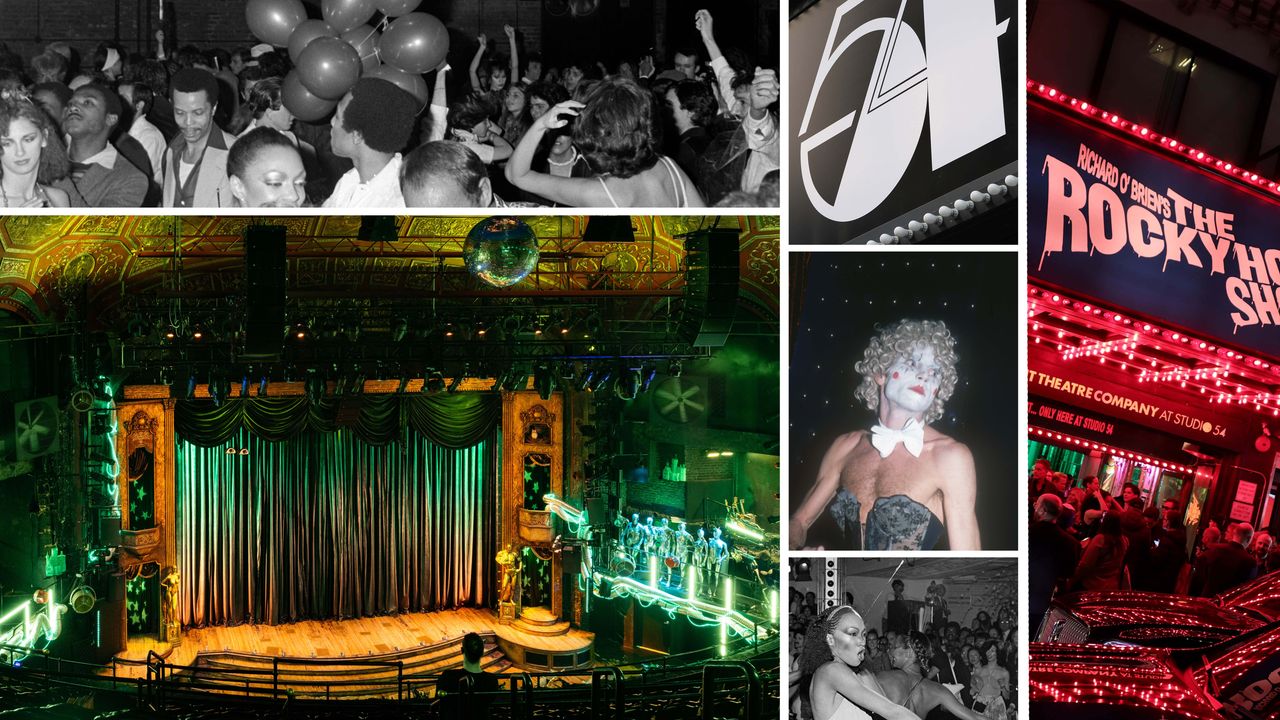
“[The Rocky Horror Show] comes with so much cultural baggage, love, and appreciation for it—so many kinds of expectations about what it looks and feels like—that we didn’t want to superimpose our own ideas onto that. We really just wanted to do the best version of The Rocky Horror Show as is written that we could,” says Andrew D. Moerdyk, a co-founder of the collective Dots, which oversaw the production design. “Not understanding where the set design begins and ends was really important for us. We wanted it to feel like Frank-N-Furter and his aliens had raided Studio 54 for inspiration and incorporated it into his castle.”
One of Moerdyk’s favorite moments of the show, he says, is when Frank-N-Furter enters the stage for the first time from the theater floor—something he likes to consider as “a direct communication with the spirits of Studio 54.” It was an element that was top of mind for the Dots team during the research period, as they referenced old photographs of Grace Jones, David Bowie, Liza Minnelli, and the many larger than life characters, living or dead, who once graced the dance floor of Studio 54 (and probably would have had a grand old time rubbing shoulders with Frank-N-Furter, too).


Ghosts were on Pinkleton’s mind from the start: “I’m very unapologetic about being woo, woo, and from the first time we went into Studio 54 [I felt it].” There is still glitter in the floorboards, he notes, and allegedly, a disused “cocaine safe” collecting dust in the basement. Before rehearsals began, Pinkleton hired Pam Grossman, a New York-based witch, to visit the space and conduct a series of rituals to introduce the cast and crew to the space. “It felt like we needed to talk to the ancestors and, in a very direct way, thank all of the people who were there before us, who I hope are all looking down on our gay little production of The Rocky Horror Show.”
After all, just as Studio 54 became an inclusive nightlife haven for experimentation and self-expression (once you got past the door, at least), so does Frank-N-Furter’s castle, where wide-eyed Janet embarks upon her sexual awakening and the slogan “Don’t Dream It, Be It” becomes the arc of the night—one that encourages you to be wackily and authentically yourself. It’s why the show remains so enduring 50 years later. “Holding on to this beautiful otherness was so core for us,” says Dots designer Santiago Orjuela-Laverde. “We figured, let’s also be ourselves as a [design] team, which is a bunch of weirdos with different points of views. I feel like the heart of Rocky Horror is that everybody is welcome to be the weirdest version of themselves on this night, and that is what I imagine Studio 54 was.”
