

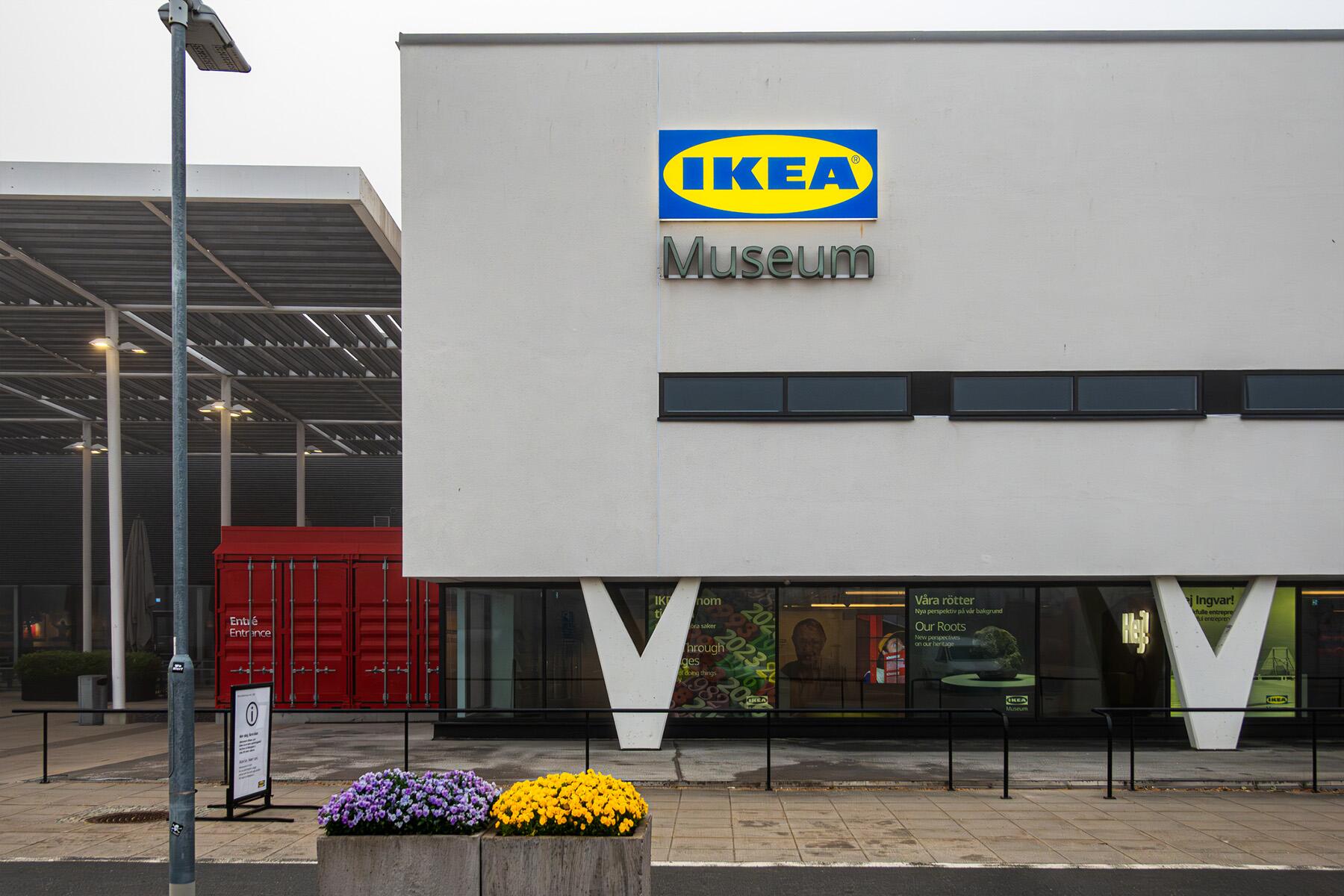
In Älmhult, Sweden, there’s an IKEA experience that doesn’t require an Allen key.
The first color that I saw in Älmhult was on a giant yellow clock. It was standing alone in an empty plaza outside the museum, a scaled-up version of Thomas Eriksson’s PS wall clock, one of those IKEA designs you’ve probably seen many times before without knowing who made it. The museum itself was a building you could walk past without a second glance. It is, I later learned, the original IKEA store, built in 1958 and converted into a museum in 2016.
I had taken the train up from Malmö that gray winter morning, 90 minutes through southern Swedish farmland. As I got close, a light snow began to fall. Älmhult has about 18,000 residents, and roughly 5,000 people in the area commute daily to IKEA for work. In this small town, more than 50 nationalities are now represented. Stepping off the train, you can go one direction toward a small town center or cross a bridge to the IKEA side, which encompasses offices, a hotel, the museum, and two restaurants all within a few hundred yards of the platform. None of it looks IKEA. The blue-and-yellow box style, as most people know the brand, does not exist here, although there is one of these stores across town near the highway. Here, everything is white, no more than three stories, and quiet.
Continue Reading Article After Our Video
Recommended Fodor’s Video
I checked into the IKEA Hotel, which is across the parking lot from the museum and outfitted almost entirely in IKEA products. Each floor has a communal kitchen with cookware and a shared seating area. Coffee was out there, not in the room. This is how Swedes think communal space should work. In my room, a sign near my bed read “Difficulties sleeping? Listen to the IKEA story here” with a QR code. I did not scan it; instead, I walked to the museum to learn more.

I ate first at the museum restaurant. The Swedish meatball is almost certainly the most widely eaten Scandinavian dish in the world—IKEA sells over a billion of them a year. Here, though, they serve them differently: meatballs, plant balls, and chicken balls in Indian-inspired, Greek-inspired versions, or over pasta with lemongrass aioli. The exported version is Swedish; the local version, it turns out, is international.
The museum is spread across several levels of the original store. It opens with a reconstruction of Ingvar Kamprad’s shed, where he started the business at seventeen, selling pens and wallets through mail order. The shed is tiny, barely big enough to turn around in. The museum spends time on this, on Småland’s stony fields and a culture of making the most of very little. It’s a story about a company, but it’s also a story Sweden tells about itself. Beside the shed, a wall displays the “humble beginnings” of Google, Apple, and others—all garages. It’s an oddly American move for a museum that otherwise trades in Scandinavian restraint.
As you move through the decades, the museum recreates room settings from each era: full living rooms, offices, and kitchens behind glass, each one unmistakably of its time. These are not what you’d expect. A clothes rack shaped into a woman’s torso next to a bed draped in netting. Bold colors on every surface. For a country that now exports restraint as a national brand, the record is surprisingly loud. The Sweden of these rooms isn’t the Sweden outside the museum’s windows.
This is juxtaposed with placards that are restrained in the way Swedish institutions tend to be–proud but unwilling to say so directly. One sign, describing the children’s play areas IKEA introduced in its stores, notes that they featured “what is perhaps the world’s first ball pit.” Not the first, but perhaps the first. This is a very Swedish sentence.
But the museum is also a study in what gets left out. There’s a recreation of Kamprad’s home office in Switzerland.

What goes unmentioned is that he lived there for nearly four decades, and that IKEA’s corporate structure was eventually registered outside Sweden. Sweden has one of the highest tax rates in the world, and the social contract that funds it is central to how the country understands itself. A company that built its identity on Swedish values while structuring itself beyond Swedish borders is a complicated story, and the museum doesn’t tell it.
Downstairs, the museum shifts from history to ethos. This is where IKEA presents its philosophy, what it calls “democratic design,” the idea that a well-designed home shouldn’t depend on how much money you make. A sign recounts how King Gustav III visited Versailles, admired a fancy chair, and had a simplified version produced back in Stockholm. The HALLUNDA chair, it notes, was based on the same original but was made in far higher numbers and assembled by the purchaser to keep prices low. It’s the throughline that the museum wants you to follow, and, judging by the group of teenagers working through the exhibits with clipboards, it’s one that Sweden is actively teaching.
On the ground floor, the museum shop is far easier to navigate than an IKEA showroom. The items are mostly unique to this location, including traditionally Swedish items such as Dala horses, fika trays, and tea towels, all available in a variety of designs. Two women stood deliberating over designs as I considered a keychain of their famous Allen key. The PS wall clocks were there too, albeit in much smaller versions than the one on the plaza.
I caught the train back to Malmö the next morning, the cold and snow falling lightly again as I crossed the plaza. I had lived ninety minutes away for years and never came. It had seemed like a company town with a company museum, and I suppose it is both of those things. It’s also, without quite meaning to be, a surprisingly good portrait of the country I now call home.

THINGS TO KNOW
The museum restaurant serves elevated takes on IKEA classics and is worth eating at. The gift shop carries items you won’t find in regular IKEA stores, including Dala horses and fika trays in designs unique to this location. Älmhult is ninety minutes by train from Malmö and roughly two hours from Copenhagen, making it an easy day trip or overnight from either city.
WHERE TO STAY
My hotel booking included free museum admission; it’s worth asking when you book. Otherwise, it’s 60 SEK for Adults; children under 18 are Free.
