

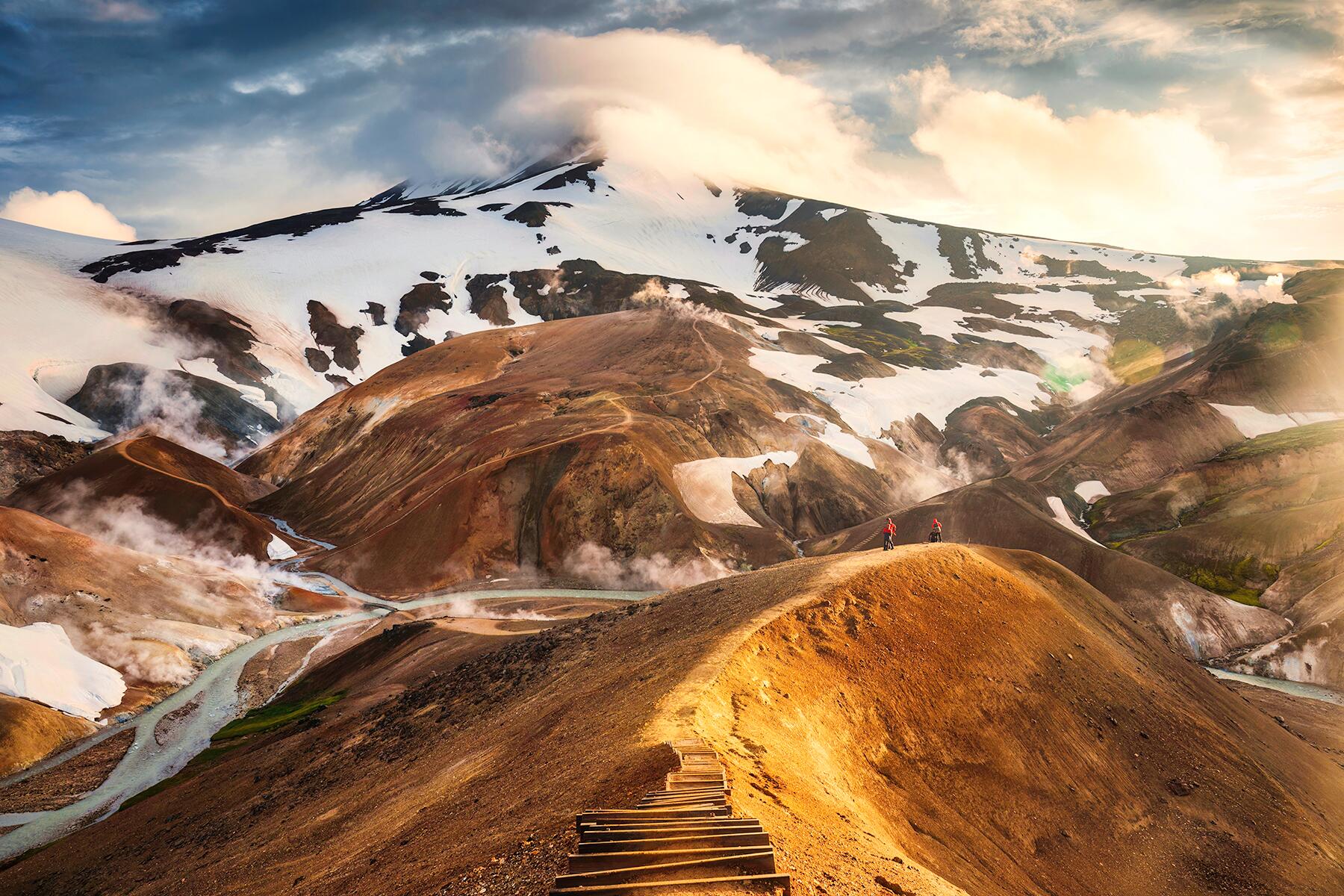
Embracing Iceland at its most desolate.
Long known as the land of fire and ice, Iceland is a place of dichotomies. The powerful geothermal heat of its volcanoes and the chilly frozen expanses of its glaciers. The overwhelming crowds of a small island dealing with a decade-long surge in tourism and its often-desolate landscapes that make you feel like the only person for miles.
On my first visit to Iceland last fall, I was, of course, drawn to all the popular reasons people come to this magical island country: the Blue Lagoon, the Golden Circle, and Vatnajökull National Park, to name just a few. But instead of these bucket list destinations, I ventured out to the least-visited region in the whole country and, like with so many roads less traveled, I ended up in one of the most spectacular places I’ve ever been.
Journey to the Highlands
Despite its glaciers and volcanoes, you might be surprised to learn how accessible most of Iceland is, especially considering its lack of a railway system. Many visitors to Iceland rent a car and navigate themselves through the country’s major regions, towns, and sights with relative ease, thanks to well-maintained highways, little traffic, and high standards of driving. The country’s famous 820-mile Route 1, also known as the Ring Road, encircles the island and goes by many of Iceland’s most popular sights, making off-road excursions unnecessary.
Yet one part of Iceland remains far off the Ring Road and indeed far away from the minds of most travelers: the Highlands. Basically, the island’s interior, this desolate region presents a formidable vision of otherworldly terrain, where vast deserts of black lava and pumice-peppered sand are enlivened by thundering waterfalls, glacial peaks, and the occasional lonely bloom.
Continue Reading Article After Our Video
Recommended Fodor’s Video
There are no towns in the region (visitors mostly talk about where they are headed in terms of road routes), and it’s mostly unpopulated, except for the Kjölur route’s Hveravellir Nature Reserve and the hotel Highland Base at Kerlingarfjöll, both of which are staffed year-round.
As I headed into what has been described as one of the last true wildernesses in Europe, I was ready to rough it. I was to travel via the Kjölur route, one of the two main routes through the interior and home to the Hveravellir geothermal area and the Kerlingarfjoll mountain range. From Reykjavik, it’s about a six-hour drive, depending on weather conditions; we had our own driver, but many people can and do make the drive themselves with rental cars. It just requires a four-wheel drive and can only be driven from mid-June through September (if you’re driving yourself, make sure you tell your rental car company where you’re going so they can make sure they give you the proper car). The first half of the journey is peaceful and well-paved, and will even take you through the famous Golden Circle and some of Iceland’s most famous spots, like Gullfoss waterfall and the Geysir and Strokkur geysers.
But once we got on the F349 (one of Iceland’s notorious rocky and unpaved F-roads), our driver shifted gears, and we were in for a slower (and bumpier) ride. We had a beautiful, sunny day, and while I was happy I wasn’t driving, it wasn’t even the scariest drive I’ve experienced. There aren’t any cliffs or harrowing turns, just bumpy, unpaved roads and an endless expanse of earth everywhere you look.
Kerlingarfjoll and Hveravellir
If you’re traveling the Kjölur route, you’re likely headed to the Kerlingarfjöll mountain range. These volcanic mountains are made up of tiny red volcanic rhyolite stones along with an array of minerals from nearby hot springs that add splashes of yellow, red, and green to the gravelly landscape that shifts as the light changes. The wide-open expanses of land here are a testament to just how deserted this place is: you can see for literal miles and not see another person.
There isn’t much in the way of vegetation, save for the volcanic moss that pops up. Really, the only thing to do in these parts is hike. Our first adventure was to find Kerlingarfjoll herself. In Icelandic folklore, trolls are creatures that roam mountain areas at night, but get turned to stone if they’re still awake by daylight. A troll woman named Kerlingarfjoll is said to have been the namesake for the mountain range, and you can find her towering jagged form on one of the area’s most popular hikes (a smaller formation beside her is sometimes called her troll child, although maybe that’s a bit too sad a tale for anyone looking for more whimsical Icelandic folklore).
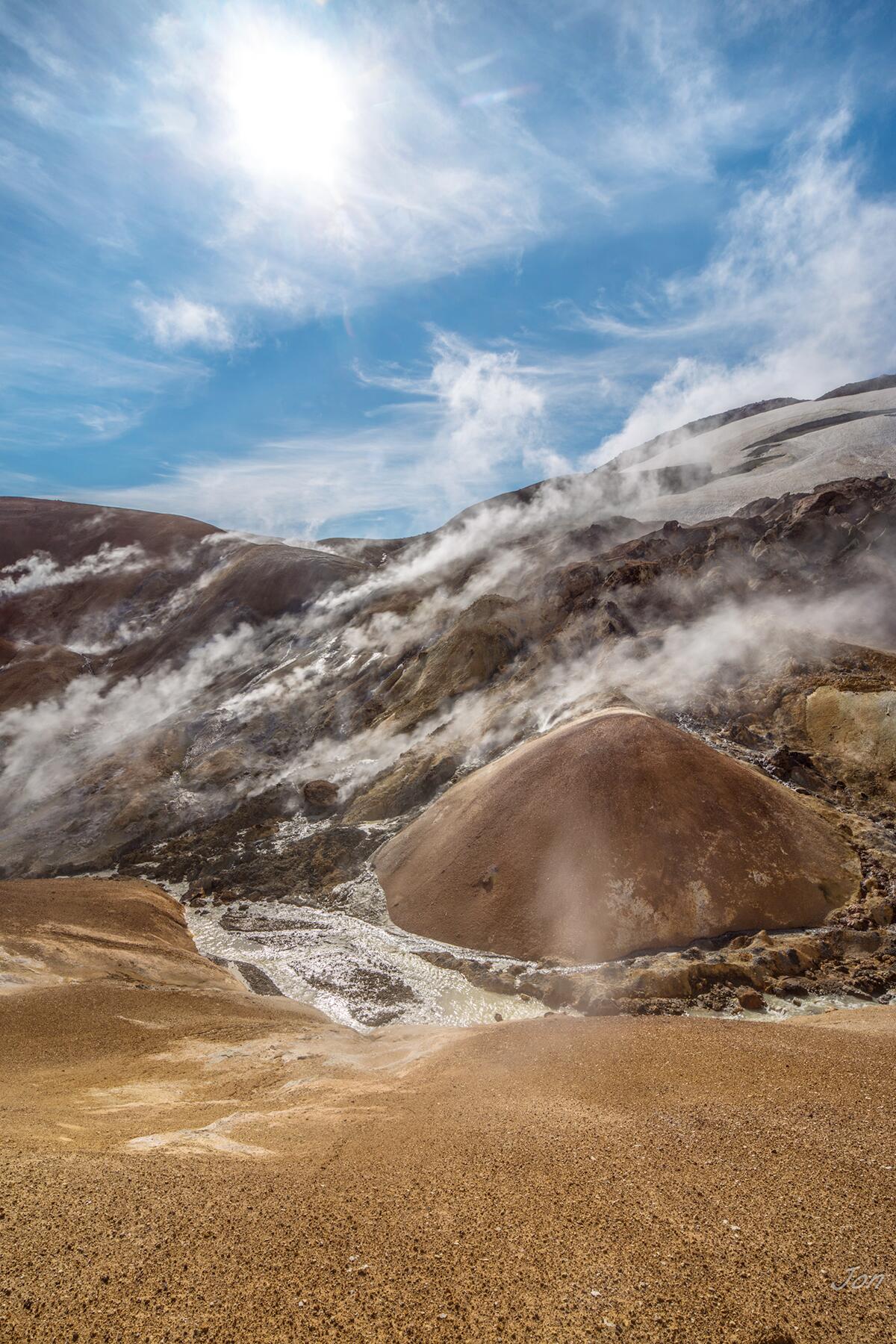

1. KerlingarfjollWikimedia Commons; 2. Hveravellir Nature ReserveStephan Kuhn/iStock
The range is also home to Iceland’s third-largest geothermal area, known as Hveravellir, another popular hiking destination in the region. Along with the rusty gravel and glacier-topped peaks in the distance, there is a beguiling amount of steaming geysers, bubbling mudpots, and the ever-present smell of sulfur radiating from the surface. Legend has it that when the Vikings first discovered the area, they thought this was literal Hell.
This was truly unlike anywhere else I’ve experienced on earth. The ochre-colored ground still spreads as far as the eye can see, with landscapes that are filled with slow-moving streams, faraway glacial peaks, and steam, really so much steam. Manmade wooden walkways take you over the bubbling hot springs, where one misstep can result in severe bodily injury. Despite all this, the four-hour hike is relatively moderate, although having a walking stick is helpful, as is being prepared for the weather to quickly change (oh, and don’t forget having a guide who knows exactly where they’re going). We were lucky and got a blue-sky day, although the wind and September chill still made coats and hats necessary.
The Highland Base
As previously mentioned, there is not much civilization around here. Many people choose to camp, but if you’d rather have an actual bed (that’s me!), the area’s one lodging option will surprise you with its luxury, especially given how sparse the surrounding landscape is. The Highland Base at Kerlingarfjöll is perhaps Iceland’s most remote hotel, located at the end of the Kjölur route, making it a great base for hikes to Kerlingarfjoll and Hveravellir (which the hotel will happily help organize with their fantastic, knowledgeable onsite guides). You can rent a campsite or one of the A-frame huts (really just a structure to put your sleeping bag in), or you can go for one of the 46 beautifully designed and irresistibly cozy guest rooms (you can also splurge for one of the 6 one-bedroom cabins). Whether you choose the cabins or the main building, the wooden structures offer refined accommodations that help to cocoon you from the harsh environment found just off the property. The muted design, with wood tones and neutral fabrics, helps to immerse yourself in nature while also offering all the expected luxe amenities (including, yet again, Blue Lagoon bath products). A large window with a daybed ensures you take some time to appreciate the view of the Highlands from your window.
An underground tunnel takes you from the rooms to the hotel’s public areas, which include a rustic restaurant that serves delicious and hearty Icelandic cuisine. It’s the only restaurant in the entire region, but luckily it doesn’t disappoint, with everything from mushroom soup with coconut cream to lamb fillet and lamb shoulder with fresh local vegetables. A nice cocktail list and wine menu are also offered, as is a daily waffle bar (free for hotel guests) that makes for a perfect welcome-back snack after a long day in the elements.
Along with hikes to Kerlingarfjöll and Hveravellir, you can also rent an e-bike to take you to a nearby waterfall or go on your own walking adventure to a nearby natural hot spring that’s open to the public and typically completely empty. Or you can spend some time in the Highland Baths, the property’s on-site pools that are heated by local hot springs; there’s also a sauna.
The Baths are a beautiful place to be at night, and if you’re there in September (or even in the winter—the property is open year-round), look up. This area is incredible for stargazing and for the Northern Lights. Both of my nights there, we saw some of the brightest stars I’ve ever seen, along with two breathtaking Northern Light shows of blues, greens, and pinks that once again reminded me just how small I really am.
