

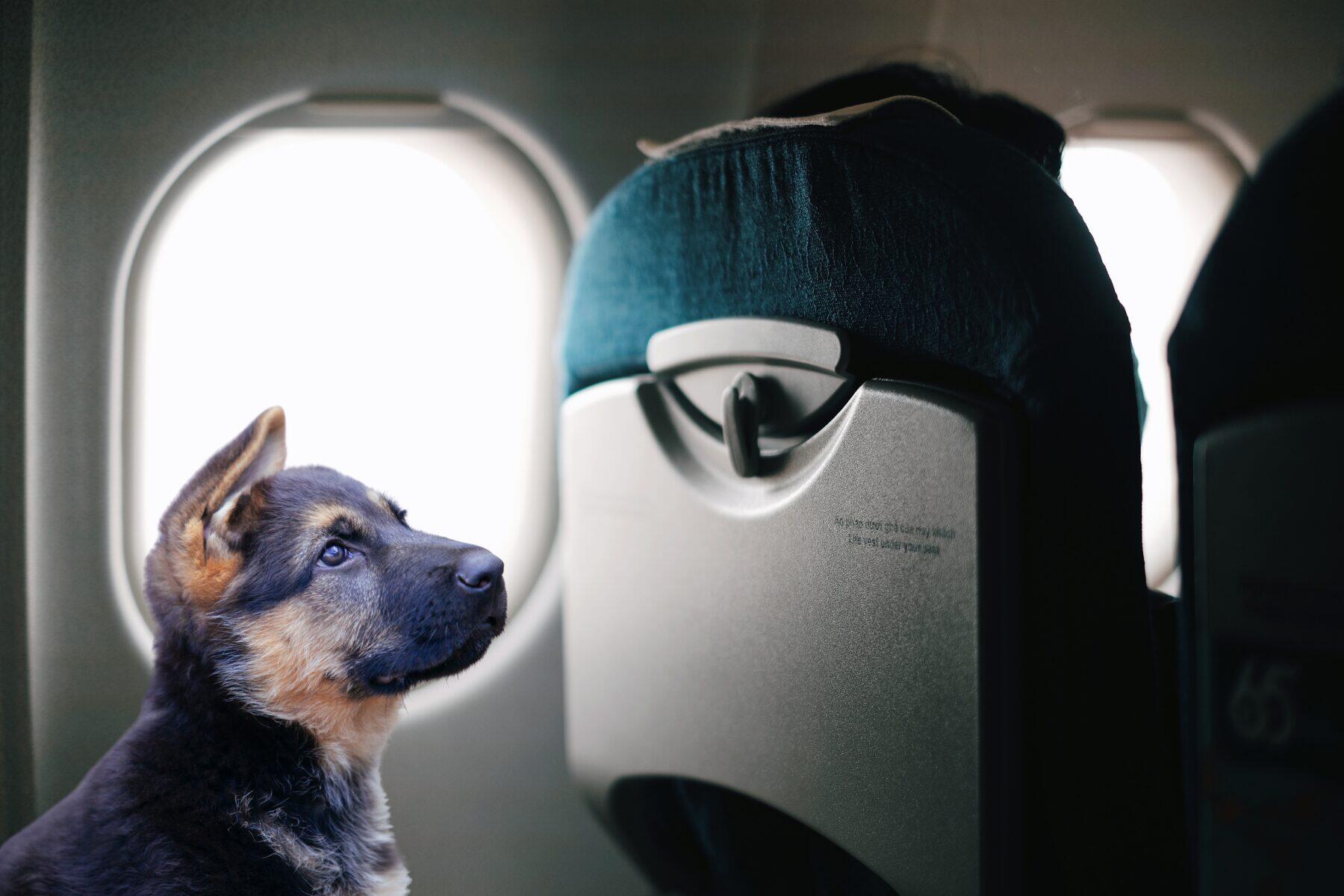
There’s barely space for humans as is.
Hot Takes is a monthly series inviting experts to share their hottest takes about travel, hospitality, and more. Have a hot take you’d like to share with us? Send your takes to [email protected] for a chance to have your take featured in a future story.
I don’t get to fly first class often, but when I do, it’s a treat—whether I’ve paid for my ticket or been upgraded thanks to my airline loyalty as a frequent flier. So, you can imagine my surprise on a flight early last year when my seatmate arrived with a personal item that barked. Yes, the passenger next to me brought her dog aboard. Despite our row being front of cabin and therefore having some extra space, her dog’s instant intrusion in my personal space prompted her to ask if I was okay with animals. She quickly followed her question by assuring me her extra passenger, which did not appear to be a service dog, wouldn’t bother me at all.
But it did bother me, and not because I was hiding a Cruella Deville Dalmatian coat in my carry-on. I’m a fan of dogs (specifically ones that are well-behaved and even better watched by their owners). But their cute furry faces don’t change the bleak reality that space on commercial flights is already at such a premium that flier’s debate whether it’s a cardinal sin to use the built-in recline function.
Flights are so overbooked these days that gate agents begging guests to check bags is basically a part of the boarding routine. If there’s barely enough room for humans to be comfortable on board, adding dogs to the mix feels unfair.
Continue Reading Article After Our Video
Recommended Fodor’s Video
The Cost of Bringing a Dog on a Plane
Travelers with pets have to pay a fee (often between $100-200 dollars) to bring their animal, but that goes into the airline’s pocket without doing anything for their neighbors’ inconvenience. This is because airlines usually don’t require owners to buy a second seat, like on United or Alaska, where the policies state that purchase is only required if a passenger brings two pets. Most airlines, like American, provide a rule that says a dog must remain in a carrier that fits under the seat for the duration of the flight as a solution.
But realistically, carriers that fully slide under (like a backpack) don’t exist, even for the smallest of dogs. This results in carriers taking up something like 20% of their neighbors’ limited leg space, when everyone paid 100% of their ticket to fly. More than that, it’s unsurprising that owners who want only the best for their pup are prone to sneaking them out of that carrier, despite the rules. Just ask pro-Dog Reddit and Facebook groups, where tips and tricks for getting your dog discreetly out of its crate are a constant topic.
Risks of Dogs on a Plane
Crated or not, with traveling canines comes their traveling hair, which many people are allergic to—as in 20% of the global population. Snack service can skip peanuts for riders with nut allergies, but there’s no way to get around canine dander (or feline dander, for that matter) circulating through recycled air.
The most disregarded people when a dog appears on a plane without warning, though, are those with animal trauma. On average, 4.5 million dog bites happen each year, with the number of hospital visits due to dog-related injuries rising 15% following the Pandemic. No one should have anxiety about their physical safety on a plane, and dogs aren’t persuaded by the threat of an Air Marshall. Sure, a dog’s owner might trust their pet to behave, but that doesn’t mean those who have been hurt by a dog before, one whose owner also trusted them to be good, have any reason to.
That’s ultimately the biggest problem with bringing an animal into a confined space: dogs come with a degree of unpredictability, and they cannot be reasoned with using explicit instructions (unless the first language-fluent dog is secretly among us). Even the sweetest dogs can go into barking fits when they get antsy, excited, or simply feel like it, let alone the ones whose parents never actively nipped this disruptive habit in the bud long before take-off; getting one to stop barking is a Herculean feat. My best noise-cancelling headphones couldn’t block out incessant barking from LAX to JFK.
Potty-trained dogs have accidents when their bladder is mismanaged in a confusing environment, and it shouldn’t be a luxury to stroll through the airport without having to dodge puddles and piles of you-know-what on the floor. If you think that doesn’t happen, you should’ve been at Nashville International Airport as I panic-steered my $300 suitcase away from a rogue turd.
The Difference Between Service Dogs and Emotional Support Animals
The obvious exception to the case for a dog-free zone are service dogs, who are a medical necessity for those with disabilities who are entitled to travel just like everyone else. Conveniently, service dogs are behaviorally elite thanks to their ADA training in special skills. But even service dogs should come with extra steps; nearby passengers should be told before boarding, and service dogs in training should have to wait until their training is complete enough that their compliance isn’t being put to the test for the first time in a high-stakes space (as is currently covered by the four-month-old rule).
It’s also unfortunate to point out that service accreditations need to be strictly verified. But considering how Emotional Support Animal certificates were used as loopholes to bring puppies everywhere (including flights until the FAA cracked down) and the availability of fake service vests on Amazon, it’s true. After being nearly bitten by a chihuahua that was a roommate’s ESA, but my emotional tyrant, I can attest firsthand how humans aren’t afraid to manipulate the system regardless of the risks.
It can be endearing that pet parents love their fur babies like children, but ultimately, dogs are not entitled to the same rights as human beings. Don’t agree? Let’s see a dog try to vote in the next election or attend college. Now, I don’t love hearing an infant’s loud tears in a metal tube, either, but I understand a fair society doesn’t discriminate against parents or children. Pawrents, however, have plenty of alternative options to make putting up with a dog’s BS from 30,000 feet unnecessary.

Alternatives To Flying With Your Dog
Airlines like BarkAir, RetrievAir, and JSX allow large dogs on board at fairly reasonable prices for the extra space that comes with flying semi-private. Outside of that, there are ground transport services that will comfortably ship your fur baby cross-country if lower cargo is a no-no. Taking a road trip to your destination may add a few days to your trip, but that might just be the fair price to pay for voluntarily taking in a four-legged friend into your family. Yes, owning a dog is ultimately a choice—one an owner makes alone, not as a community decision, and so they should take on the associated costs alone too.
Being squished next to man’s best friend is a welcome surprise for serious animal lovers, but the truth is nobody must love your dog—or any dog at all—but you. R/Dogfree has 40,000 weekly visitors with passionate arguments about the inconvenience of dogs to prove it.
Though it feels alien to animal lovers who are comfortable kissing a being that licks their nether regions on the mouth, some people simply do not like dealing with the hair, germs, smell (yes, there is always a smell), and the forced awareness that comes with managing a dog in your space, lest they eat your food or want to explore without your consent. Spending hundreds, sometimes thousands, on a trip shouldn’t also cost the dog-free community their autonomy in a space where dogs don’t have to be.
