

Decibel monitors, defined as “devices that assess sound levels and their duration but do not record audio,” are allowed indoors, as long as the area of the rental where the monitor is placed is disclosed to guests; however, hosts do not have to disclose the exact location of the device itself.
Smart home devices that do not fit the criteria of security camera, recording device, or noise decibel monitor—such as lighting fixtures like Philips Hue bulbs, thermostats, and smart plugs—are permitted inside Airbnbs. They are not required to be disclosed on the rental listing, but hosts may choose to disclose the presence of these devices and allow guests the ability to unplug or disable them during their stay.
Booking.com
Booking.com, a popular hotel booking platform, has greatly expanded its vacation rental offerings since listing its first apartment in 2000. Today, rentals make up an estimated 8.4 million out of the total 31 million-plus listings on their site.
Starting in April 2024, Booking.com banned cameras from all indoor spaces as well as outdoor areas with a reasonable expectation of privacy (like patios and saunas, for example) across their global listings, according to the site’s latest privacy policy.
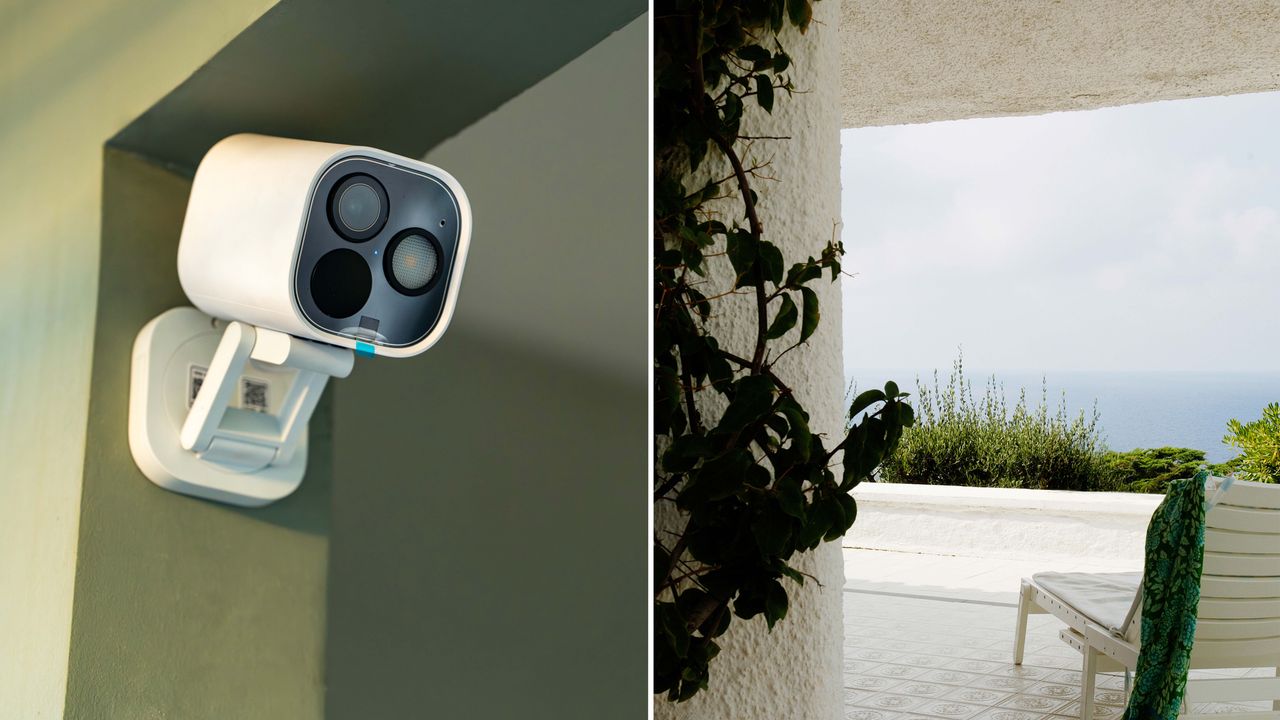
External security cameras are allowed for Booking.com listings, as long as they are disclosed to guests. “As outlined in our latest updates, we require partners to disclose any device that can monitor, record, or transmit images, audio, video, or motion,” says Sage Hunter, the North American lead of communications at Booking.com. “This includes modern devices like Wi-Fi cameras and video doorbells.”
Booking.com also requires rental listings to inform guests of CCTV, decibel monitors, and motion detectors installed on the exterior of the property. “These may only be used in clearly defined common or outdoor areas and must be transparently listed in the Safety & Security section of the property’s listing so guests are informed before they even book,” says Hunter. The company does not require hosts to include instructions for guests on how to unplug or disable exterior surveillance devices.
Vrbo
Vrbo, often cited as the first online booking platform for vacation rentals, has banned indoor cameras from its listings since at least 2023.
“Surveillance devices capturing the inside of a property are never allowed in listings on our platform,” says Alison Kwong, senior manager of public relations at Vrbo. Vrbo defines a surveillance device as anything that captures photos, audio recordings, videos, geolocation, personally identifiable information, or monitors data on the internet.
However, Vrbo’s current policy on surveillance devices states one notable exception: “Smart devices that can’t be activated remotely are allowed, as long as guests have been informed of their presence and are given the option to deactivate them.”
“Outside a property, devices such as external security cameras or smart doorbells are only allowed under specific rules, and the host must always disclose their presence,” says Kwong.
Vrbo’s rules regarding external security cameras include: (1) devices should only be used for security purposes and oriented towards an access point, (2) they cannot be angled such that the interior of a home is in view such as being pointed towards a window, and (3) on the listing page, the location of the device and its coverage area is mandatory (i.e. a camera on the front door which oversees the driveway)—a photo of the device alone does not suffice.
