


There is a problem so old it predates civilization, so universal it has been solved independently on every continent, and so stubbornly persistent that we are still arguing about it today.
How do we keep the weather out?
Every waterproof jacket ever made is an attempt to answer that question in our long war against rain. Some of them are marvels of engineering. Some of them are marvels of craft. A few are both. And the story of how we got from one to the other is stranger, more interesting, and more humbling than the hang tags on your shell jacket would have you believe.
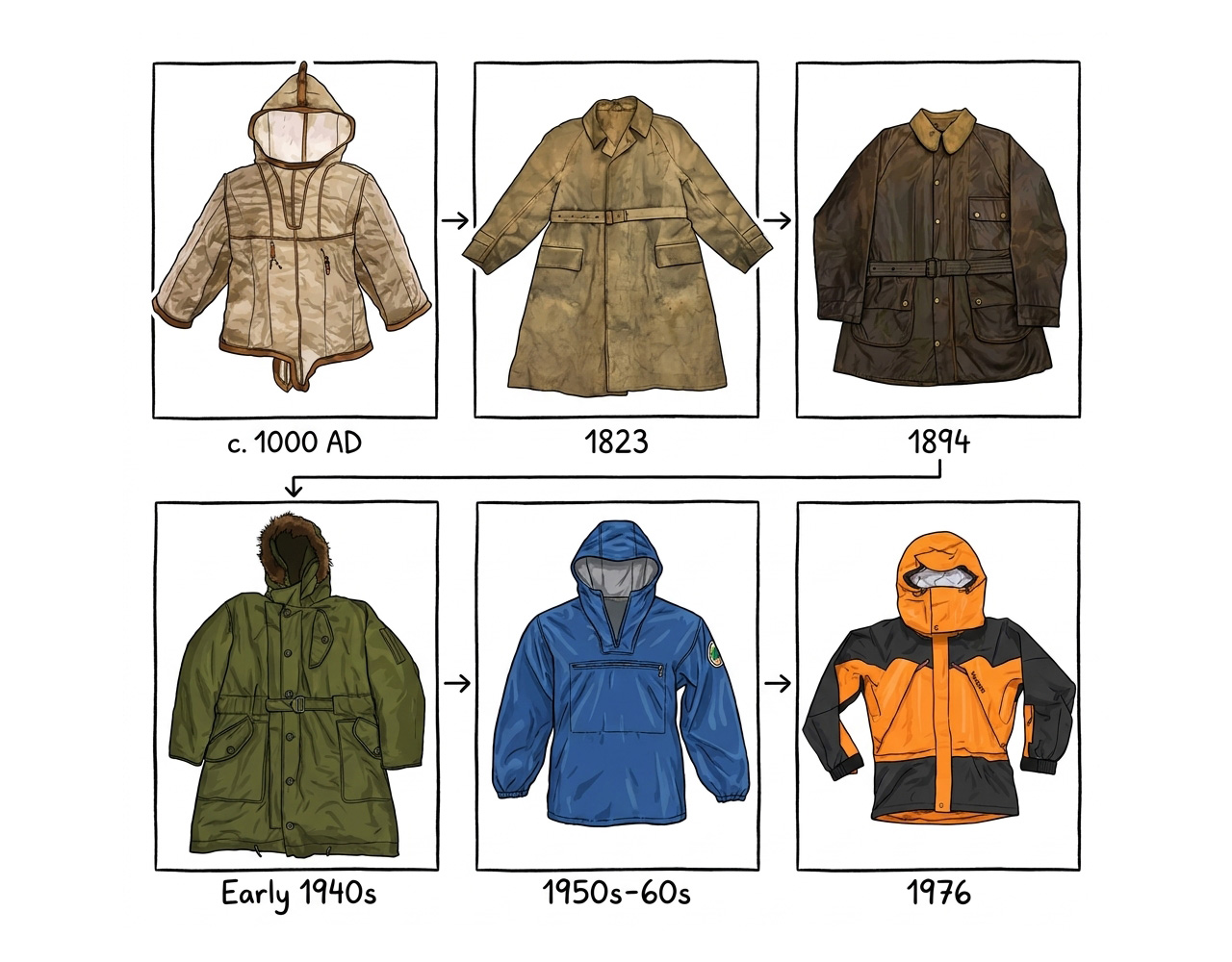
The Gut Parka
(Invented 1000+ years ago)
Before rubber. Before nylon. Before Gore-Tex. Before any of it.
Somewhere on the Aleutian Islands, a person sat down with a sea lion intestine, a bone needle, and thread made from sinew, and began to sew.
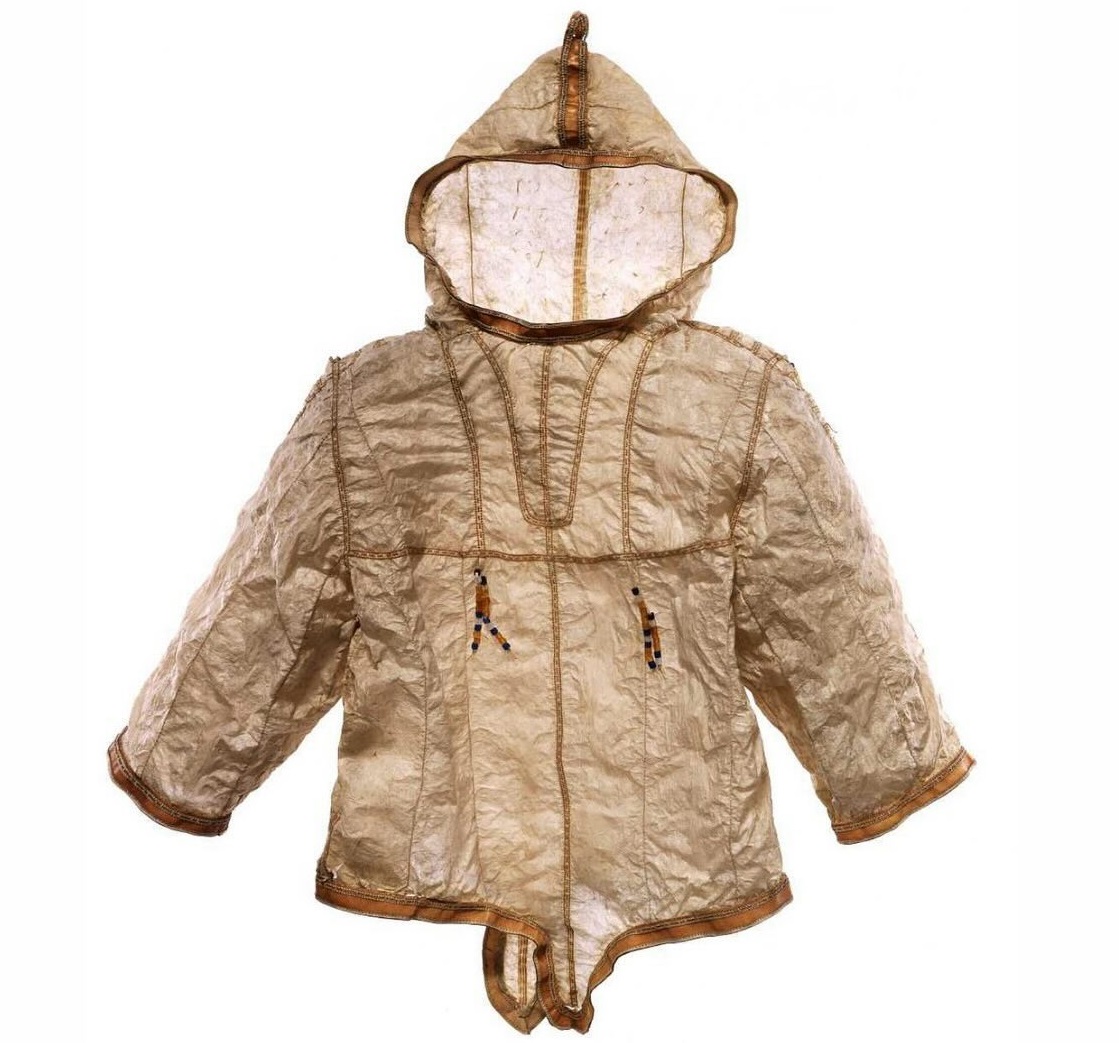
The garments they made, called kamleikas by the Aleut and gut parkas by those who encountered them later, were by any honest measure among the most sophisticated pieces of waterproof outerwear ever constructed. Indigenous peoples across Alaska and the Arctic, including the Aleut, Alutiiq, Inupiat, and Yup’ik, had developed a technology so refined that it would not be meaningfully improved upon for centuries.
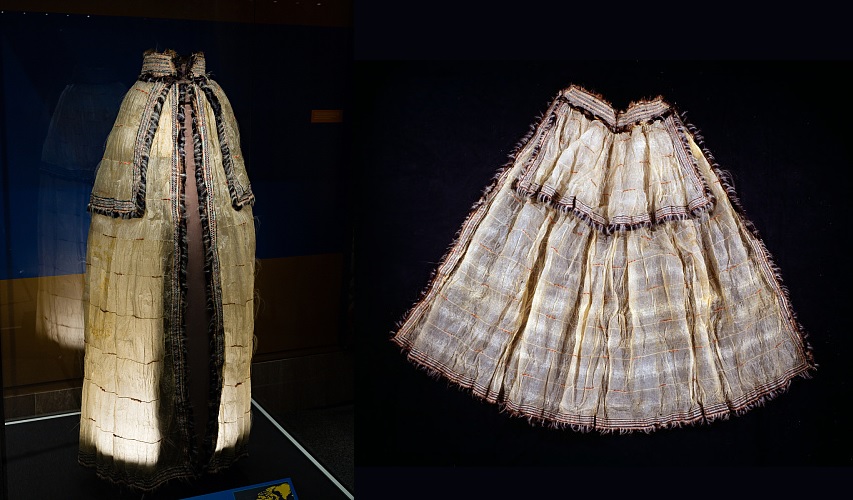
The process was painstaking. Animal intestines, from sea lion, bear, walrus, and seal, were harvested, cleaned, split into long strips, and dried. The strips were then sewn together in horizontal rows using a blind stitch so tight and precise that no water could penetrate the seam. The resulting fabric was extraordinarily thin, almost translucent, and lighter than anything a European tailor of the same era could have imagined. It moved with the body. It shed water completely. And in the hands of an expert maker, it lasted years.
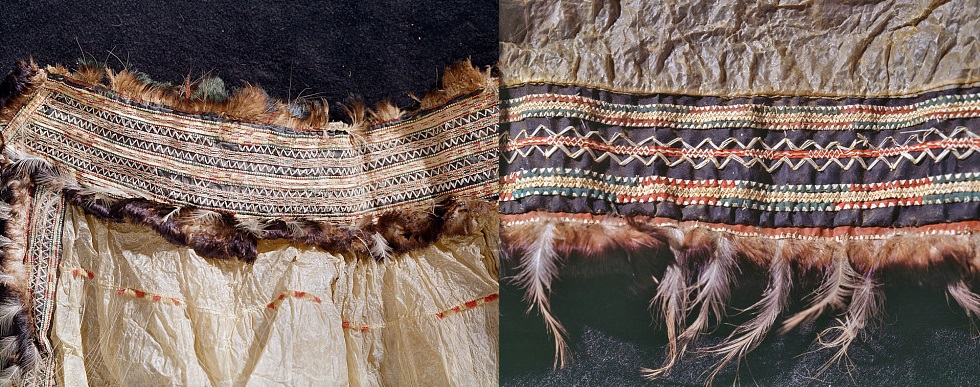
The kayak anorak, a hooded gut parka designed to be lashed to the cockpit coaming of a baidarka, created a sealed system robust enough for rolling and rough water travel in the North Pacific — the paddler and the boat effectively becoming one waterproof unit. This was not a garment for walking between a carriage and a doorway. It was life support equipment for ocean travel in some of the most hostile waters on earth.
What makes this remarkable is not just the waterproofing. It’s the breathability. Gut fabric, unlike rubber or coated nylon, is a membrane. It blocks liquid water while allowing water vapor to escape. The Aleut and their neighbors had, through centuries of careful observation and craft, arrived at a solution that Western science would not formally rediscover until 1969.
The gut parka is not a footnote in the history of waterproof clothing. It is the opening chapter, and one that most of that history has been too quick to skip.
The Mackintosh
(1823)
In 1823, a Scottish chemist named Charles Macintosh patented a method of bonding rubber between two layers of fabric. The resulting material was, by the standards of the time, a revelation: genuinely, reliably waterproof. You could stand in the rain and stay dry. This had not previously been something you could buy.
The problems were immediate and considerable.
In cold weather, the rubber stiffened until the coat moved like a suit of armor. In warm weather, it softened into something approaching a swamp. The smell, in either condition, was memorable. Breathability was not a concept that entered into the equation at all. The Mackintosh coat kept rain out with the same indifference to the wearer’s comfort as a bin bag.
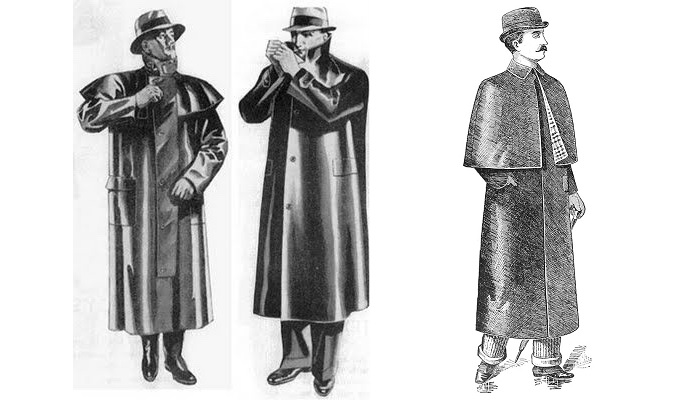
People wore them anyway, because the alternative was getting wet, and getting wet could kill you. The Mackintosh was not a pleasant garment. It was a necessary one.
It was also the first waterproof coat that ordinary people in the industrial world could actually buy. That matters. The gut parka was a masterwork of indigenous craft, produced by specialists for a specific environment. The Mackintosh was a mass-produced commodity, available to anyone who could afford it. Democratization has always had trade-offs.
Waxed or Oiled Cotton Jackets
(19th Century)
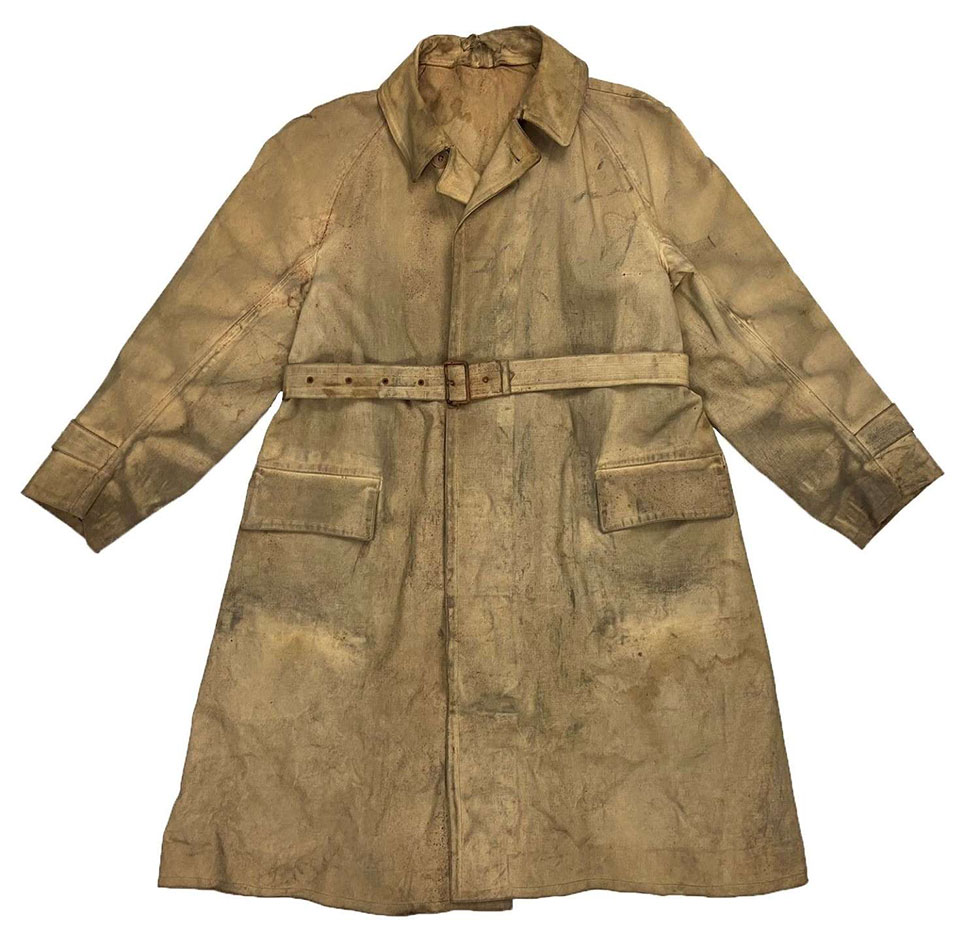
By the late nineteenth century, sailors and outdoorsmen had arrived at a different solution: waxed and oiled cotton. Barbour, founded in 1894 in South Shields, became the most famous name in a tradition that stretched back to the oilskin coats of working fishermen, heavy, dark, smelling faintly of linseed, and about as supple as a tarpaulin.
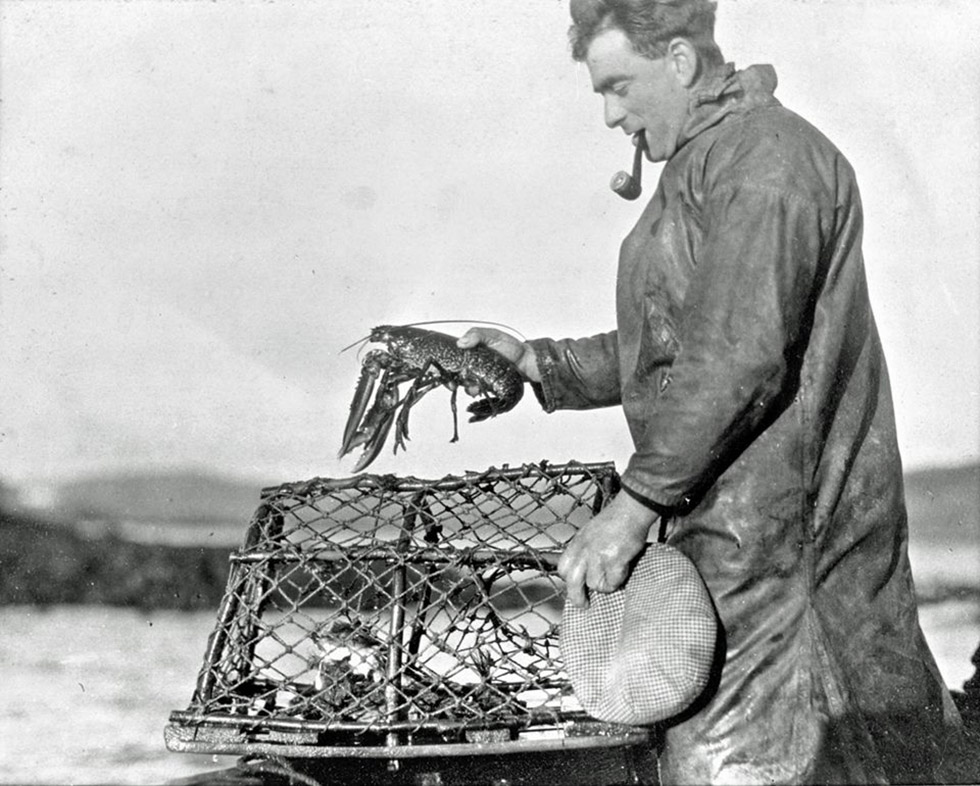
These coats worked, after a fashion. They shed water reasonably well in moderate conditions. They were durable. They developed a patina that their wearers came to regard with something approaching affection. But they were heavy. They were stiff. In driving rain, they eventually became saturated.
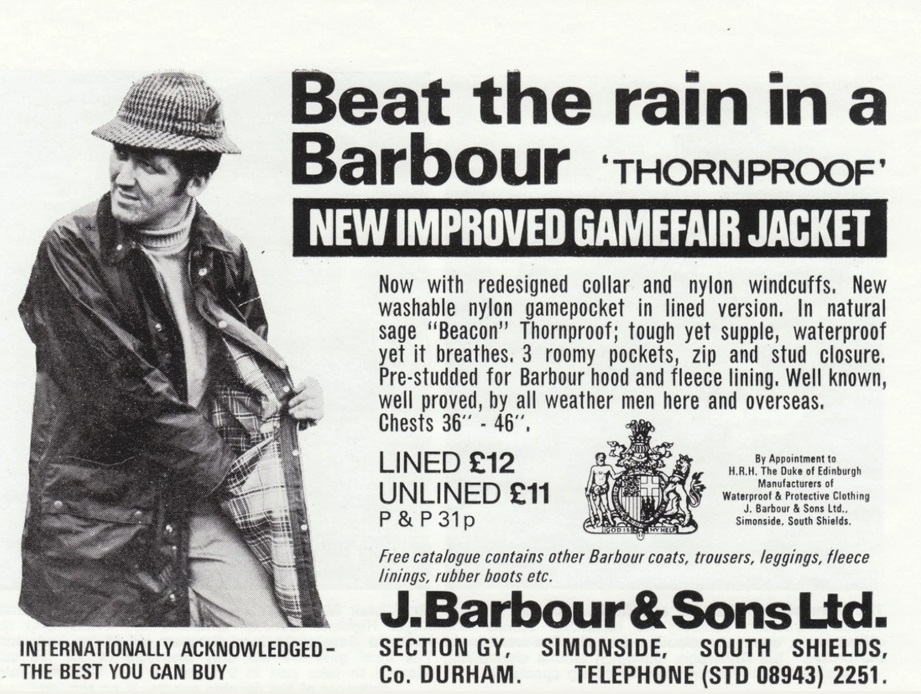
The waxed cotton coat was not a technical solution. It was a cultural one, a garment that said something about who you were and how you spent your time, that happened to keep you reasonably dry while you were doing it. That distinction matters because it never entirely went away.
Ventile Jackets
(1940s)
World War II did what it always does to materials technology: it accelerated it by decades.
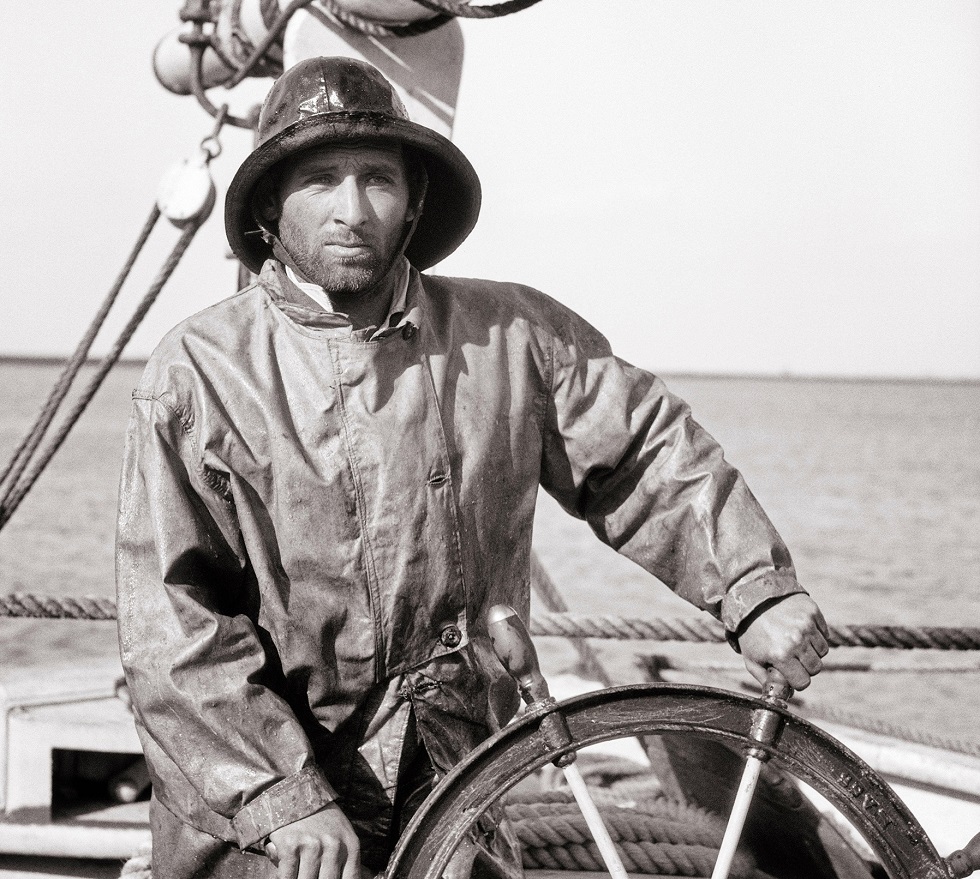
The RAF needed survival suits that could keep downed pilots alive in the North Sea. The answer was Ventile, an extraordinarily tightly woven long-staple cotton developed in Britain in the early 1940s. The principle was elegant: weave the cotton so densely that when the fibers got wet, they swelled and closed the gaps between them, blocking water without any coating or membrane at all. A Ventile suit could keep a pilot alive in cold water for critical extra minutes, and it was, by the standards of the era, remarkably breathable.
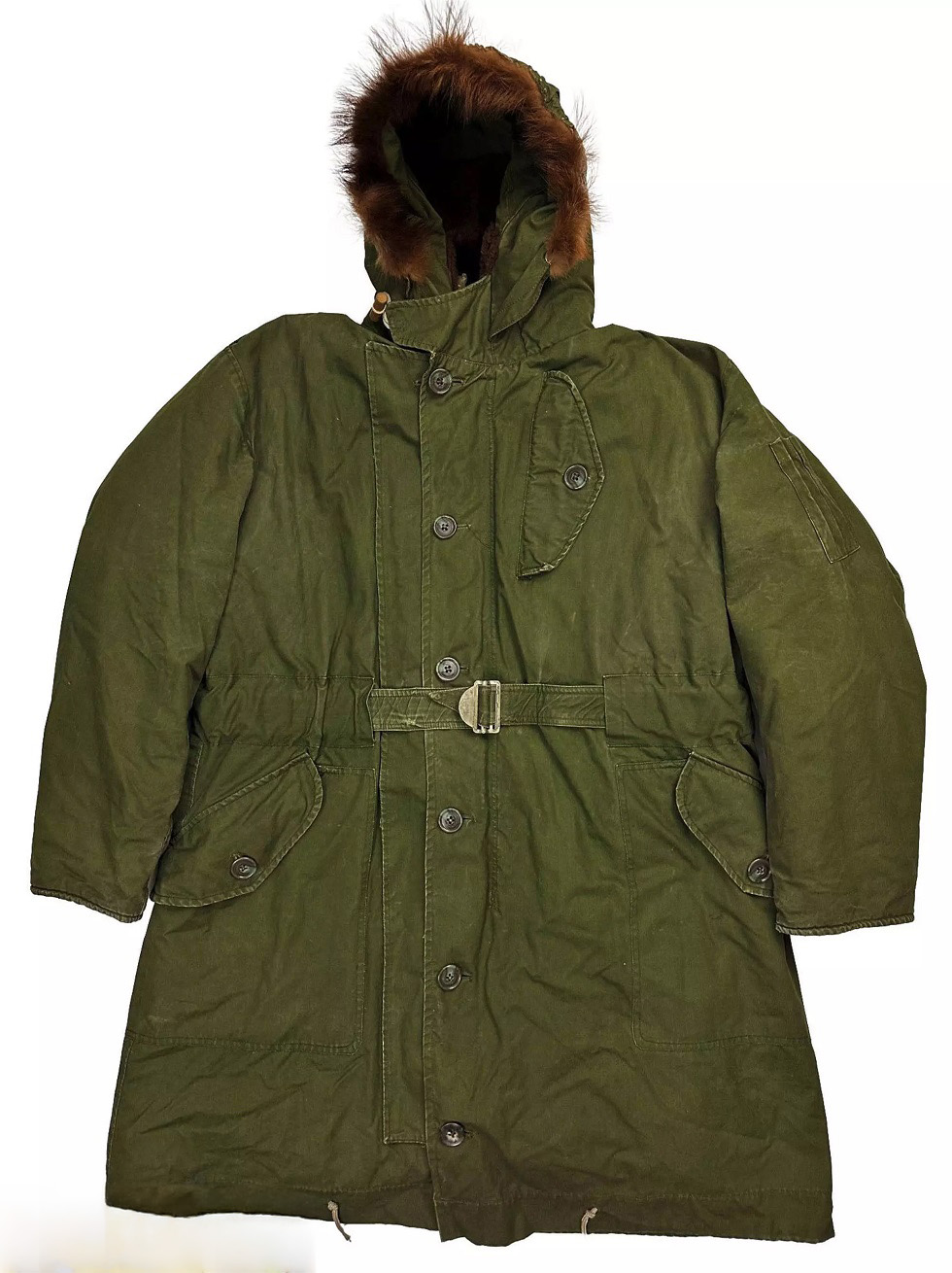
Ventile never became a mass-market product. It was expensive to produce, slow to manufacture, and by the time the war ended, nylon was arriving to change the conversation entirely. But it established something important: that the answer to waterproofing didn’t have to be “seal it completely.” You could work with the fabric itself.
Nylon Jackets
(1950s and 60s)
Meanwhile, nylon, lighter, stronger, and cheaper than anything that had come before, was flooding into the outdoor market. By the 1950s and 1960s, climbers and hikers had access to lightweight nylon shells coated with polyurethane: the first jackets that looked, in silhouette, like what we’d recognize as a rain shell today. They were packable. They were light. They were genuinely waterproof.
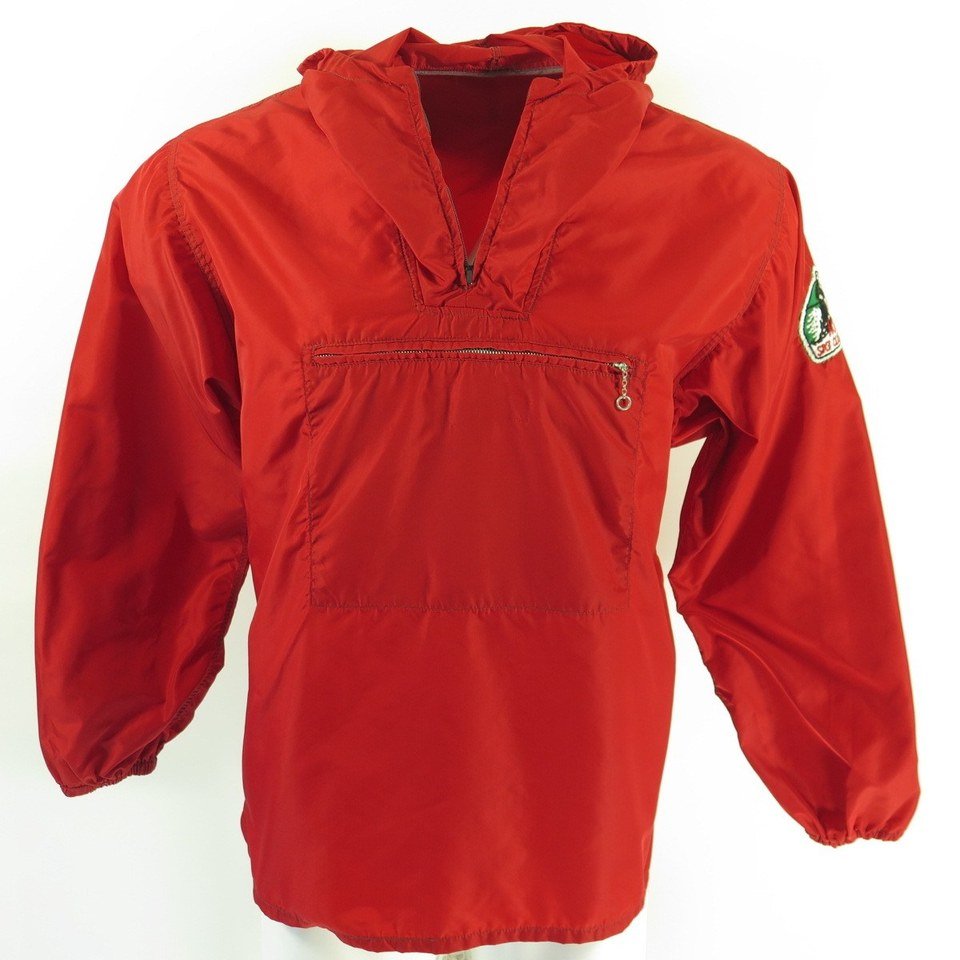
They were also, inside, like a sauna.
The coatings that kept water out kept everything out. Sweat had nowhere to go. You stayed dry from the rain and soaked from the inside. The coating cracked with age. And serious mountaineers, who needed to move hard in bad weather and survive the consequences, were not impressed.
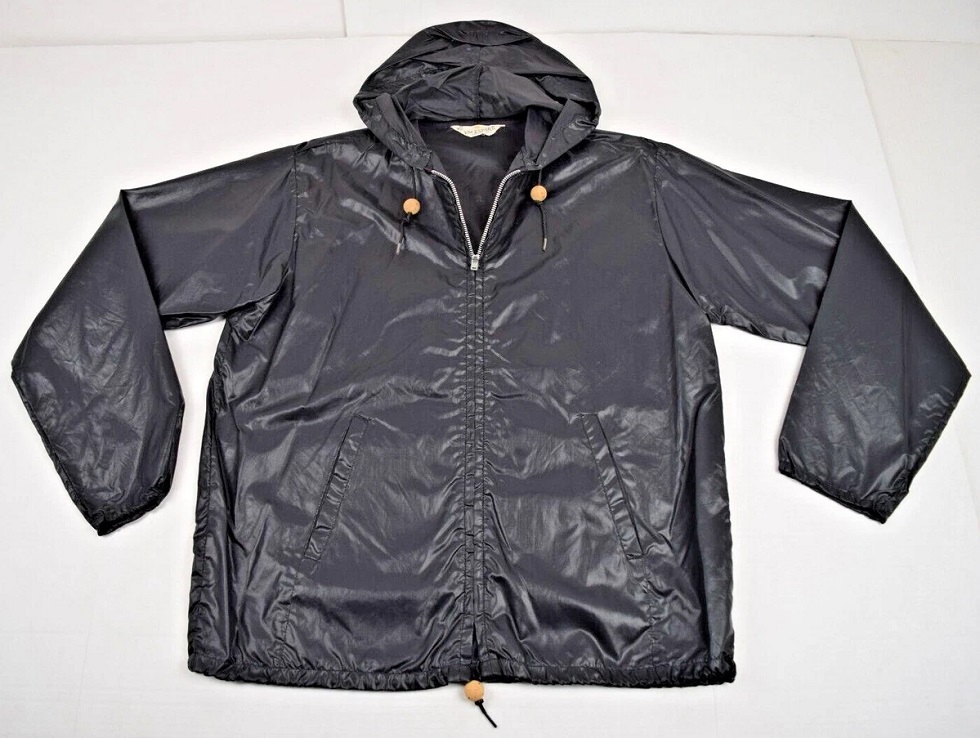
The problem had been restated, not solved. You could have waterproof, or you could have breathable. Not both.
Gore-Tex Jackets
(1970s)
In 1969, a materials scientist named Bob Gore was trying to stretch PTFE, the polymer better known as Teflon, quickly rather than slowly. The received wisdom was that you stretched it slowly. Gore yanked it. The material didn’t break. Instead, it expanded into a microporous structure: billions of tiny holes, each one seven hundred times larger than a water vapour molecule and seven hundred times smaller than a droplet of liquid water.
He called it expanded PTFE, or ePTFE. We came to call it Gore-Tex.
The logic was almost absurdly simple once you saw it. Water vapour, the sweat trying to escape your body, is a gas. Liquid water, the rain trying to get in, is a liquid. If you could build a membrane with pores sized precisely between those two states, you could let one through while blocking the other. Waterproof and breathable. The thing that had seemed like a contradiction for a century and a half.
W. L. Gore & Associates launched the first commercial Gore-Tex outerwear fabrics in 1976. The early reception was mixed, to put it charitably. Body oils contaminated the membrane, lamination was inconsistent, and some jackets sold as waterproof turned out not to be. Mountaineers, who had been promised miracles before, were skeptical.
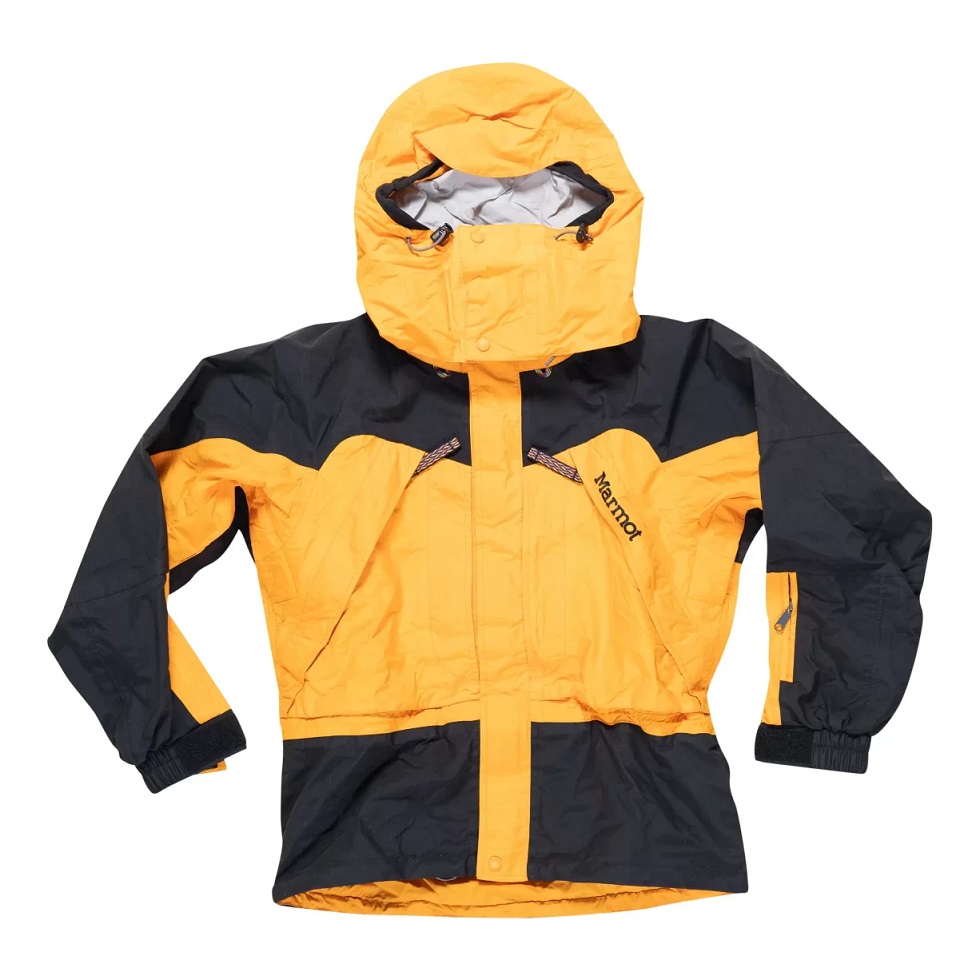
But the engineers kept working. Lamination improved. Seam taping, the process of covering every needle hole with a waterproof tape, became standard. By the early 1980s, serious climbing and ski brands were building Gore-Tex shells with storm hoods, pit zips, and fully taped seams: the technical mountain shell, essentially as we know it today.
The gut parka makers of the Aleutian Islands would have recognized the principle immediately. It had taken Western industry two hundred years to get there.
The Peak Was Loud
For a long time, Gore-Tex was simply the answer. If you needed to be outside in serious weather, you wore it. The black diamond label meant something specific: this garment will not fail you when conditions get bad. That promise, reliably kept, built a kind of loyalty that most brands can only dream of.
Then, somewhere around 2020, something shifted.
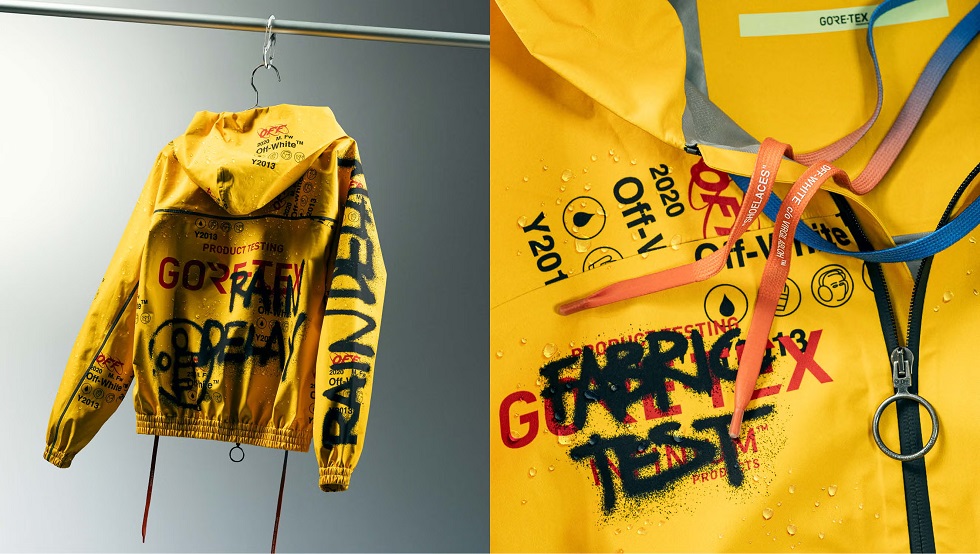
Gorpcore pushed Gore-Tex shells to the center of fashion. Arc’teryx Beta jackets and Acronym J-series pieces became grail objects. Short-form video loved the money shot: water beading off a sleeve in perfect spheres, rolling away like mercury. The Gore-Tex logo went from specialist credential to style signal.
And then, as fashion always does, it started moved on.
Quiet luxury arrived. Softer silhouettes. Natural fabrics. The visual language began to break off from expedition gear. A lot of people who had bought Gore-Tex as a fashion piece discovered its actual character: it needs layering, it needs DWR maintenance, it crinkles when you move, and it is significantly overbuilt for a walk to a coffee shop.
Gore-Tex was drifting back to what it had always actually been: a specialist tool.
The Reckoning of Gore-Tex
Gore-Tex works. In a laboratory, it works beautifully. Stretch a piece of ePTFE membrane across a pressurized tube of water at 40 PSI and it holds. Not a drop gets through. Leave it over a cup of absorbent beads in a humid room for eight hours and yes, it breathes. The physics is real. The membrane does exactly what it claims.
The problem is that you don’t wear your jacket in a laboratory.
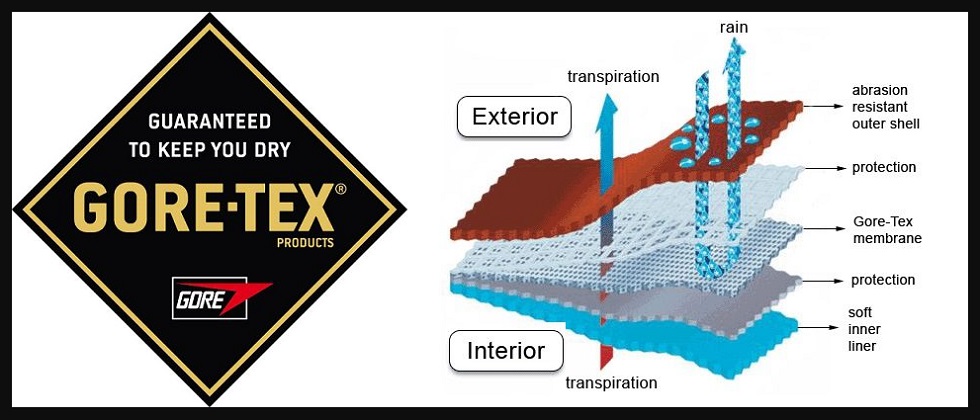
To understand why, you need to understand one thing: Gore-Tex doesn’t push water out. It doesn’t suck air in. It is passive. It just sits there, full of tiny holes, and waits for nature to do the work. Specifically, it waits for a difference in humidity between the inside of your jacket and the outside.
Think of it like this. Imagine you have a room full of people on one side of a door, and an empty room on the other side. Open the door and people will naturally drift toward the empty room. That’s how Gore-Tex breathes. The sweat building up inside your jacket is the crowded room. The cold, dry air outside is the empty one. Open the door, and moisture moves through.
Now imagine both rooms are equally packed. Nobody moves anywhere.
That’s what happens when it rains.
When the air outside your jacket is already saturated with moisture, there’s nowhere for your sweat to go. The humidity differential that drives breathability simply disappears. The membrane is still there, still full of its billions of tiny holes, still technically capable of breathing. But without the pressure difference to push vapour through, it doesn’t. You stay wet from the inside, even as the jacket keeps the rain out from the outside.
There’s a second problem, and it’s sneakier.
Even on a day when the conditions are right, the moment the outer fabric of your jacket gets truly soaked, a thin layer of liquid water forms against the membrane. Your sweat vapour travels through the membrane, hits that cold wet layer, and turns back into liquid. It condenses and runs back in. The jacket is functioning perfectly. You are still damp on the inside.
The industry’s fix for this is DWR, a Durable Water Repellent coating applied to the outer fabric. DWR makes water bead up and roll off rather than soak in, which keeps that outer layer dry, which keeps the membrane clear, which lets the breathability work. When DWR is fresh, the system functions as advertised. But DWR wears off. It washes out. It needs to be reapplied. And once you notice that the thing keeping you dry is actually the coating on the outside rather than the membrane underneath, a reasonable question presents itself: if the outer layer is doing the waterproofing, what exactly am I paying for?
None of this makes Gore-Tex a fraud. It makes it a conditional technology. It performs genuinely well in cold, dry air when your body is working hard, which is exactly the condition it was designed for: a climber moving fast in alpine weather. In those circumstances, the humidity differential is large, the DWR is doing its job, and the membrane earns its reputation.
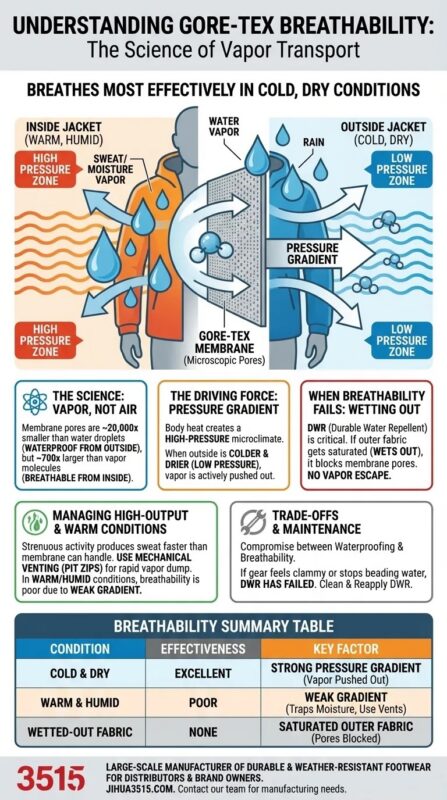
But most people are not alpine climbers. Most people are walking to work in a drizzle, or standing at a trailhead in steady rain, or trying to stay comfortable on a bike commute. In those conditions, the gap between what Gore-Tex promises and what it delivers is real, and it is not small. The honest version of the marketing line would read something like: waterproof and breathable, when it’s cold outside, when you’re working hard, and when the jacket is well-maintained. That’s a harder sell. It’s also the truth.
The Gatekeeping of Gore
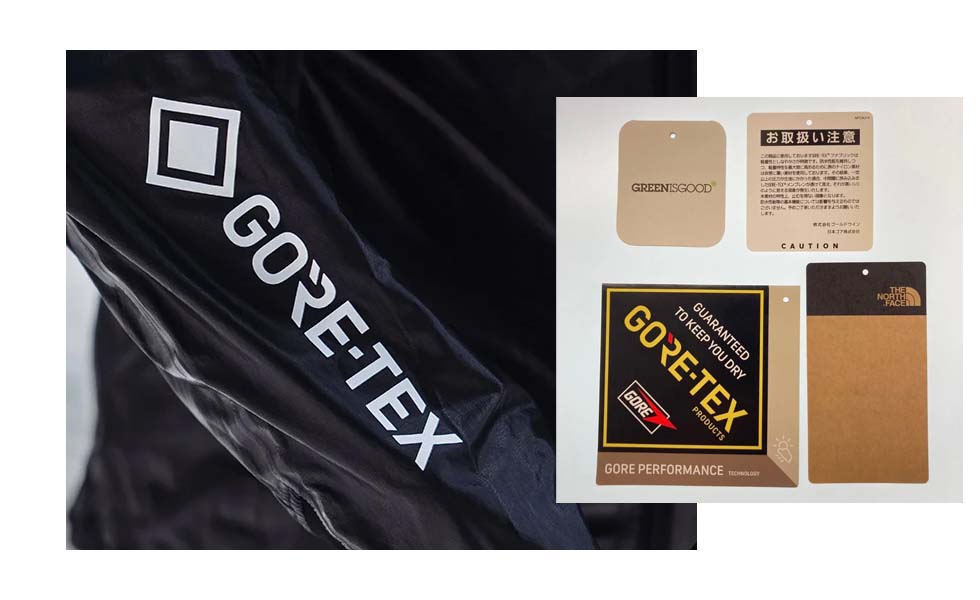
What compounded the reckoning was the business model behind the badge. During the years when Gore’s original ePTFE patents were in force, any manufacturer wanting to use the membrane had to use Gore-approved machinery, buy Gore’s seam tape, put Gore-Tex in the product name, and hang the black diamond tag on every garment. The patent expired in 1998. For the last quarter-century, anyone can make ePTFE. But by then, the brand had become the category. Consumers had been trained to see the black diamond as the hallmark of outdoor quality, and manufacturers found themselves in an uncomfortable position: they knew their own membranes were competitive, sometimes better, but without the Gore-Tex label, their flagship products wouldn’t sell at flagship prices. Some brands ended up licensing Gore-Tex for their premium lines while their own in-house membranes performed comparably in real-world testing. The name had become the product, regardless of what the product actually was.
The PFAS Problem
Then came the PFAS problem. Gore-Tex’s ePTFE membrane is a fluoropolymer, and the DWR coatings applied to most waterproof shells have historically relied on PFAS, per- and polyfluoroalkyl substances sometimes called “forever chemicals” for their persistence in the environment and in human bodies. Regulators in Europe began moving toward bans. The industry that had built its identity around loving the outdoors found itself reckoning with what it was leaving behind in it.
Gore’s answer is ePE, expanded polyethylene, a next-generation membrane that reduces fluoropolymer use. But the transition is complicated: PFAS appear elsewhere in supply chains, breathability trade-offs are real in early versions, and the full picture isn’t yet clear. There is also a certain poetry in the situation. Modern Gore-Tex, in moving to polyethylene and polyurethane membranes, has arrived at the same materials that smaller manufacturers spent decades developing specifically to work around Gore’s original PTFE patent. The category leader is catching up to its own competition.
The Alternatives
Gore’s patents expiring in 1998 didn’t immediately produce a flourishing competitive market. The brand’s grip was too strong for that. But it did produce a generation of membrane engineers who were free to experiment, and some of what they built is worth understanding properly.
The honest answer about Gore-Tex alternatives is this: most of them share the same fundamental physics problem. They are all membranes. They all rely on a humidity differential to breathe. They all struggle when the outside world is as wet as the inside of your jacket. The laws of thermodynamics do not make exceptions for brand loyalty or price point.
But within those shared constraints, the differences are real, and in some cases they matter.
eVent
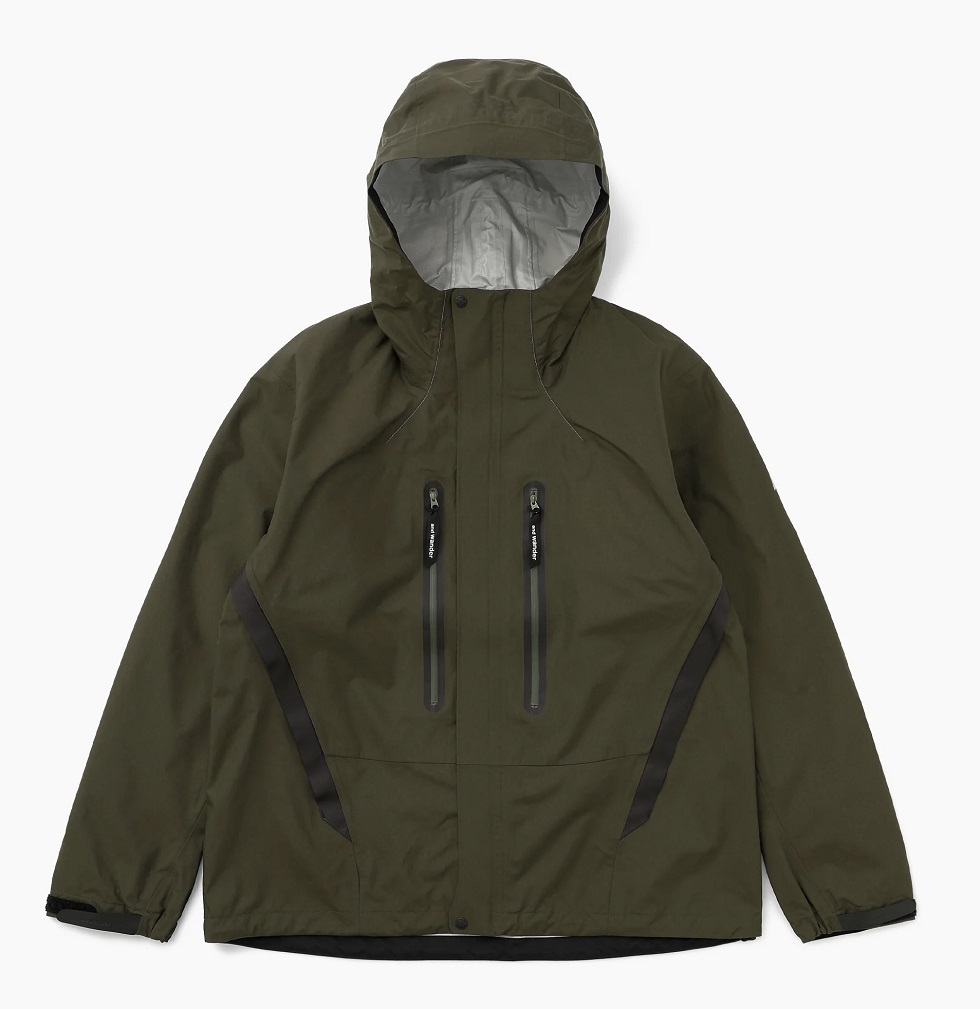
eVent (now owned by Eschler Textiles) takes a different structural approach to the same ePTFE material. Where Gore-Tex laminates the membrane between fabric layers and relies on DWR on the outer face to keep the membrane surface dry, eVent uses a process called Direct Venting: the membrane fibers are treated so that the pores remain open even when the outer fabric is wet. In theory, this means eVent breathes more consistently in real rain conditions, because it isn’t waiting for the outer face to bead. Independent testing has generally supported this. The trade-off is durability: the open-pore structure is more vulnerable to contamination from body oils and detergents over time, and eVent garments require more careful washing. It is a genuine engineering trade-off, not a marketing one.
Neoshell
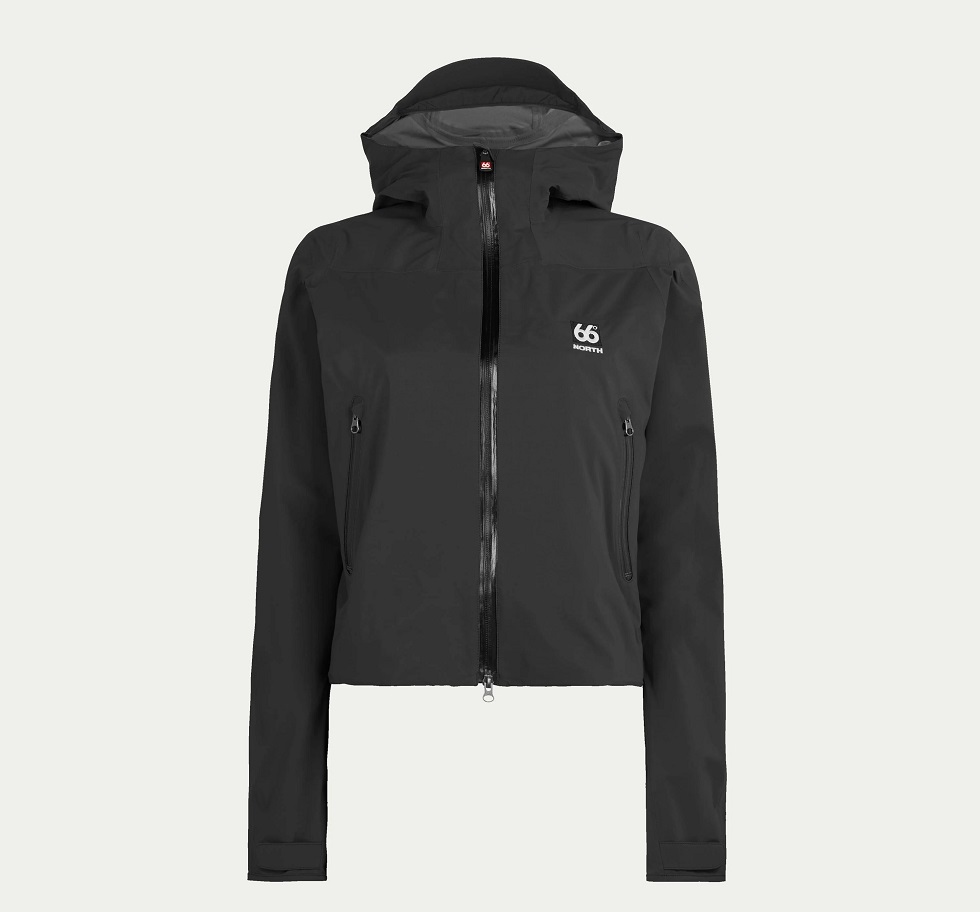
Neoshell, developed by Polartec, represents a more radical departure. Rather than a microporous membrane, Neoshell uses a mechanically breathable structure, a highly elastic, air-permeable laminate that moves air through physical stretch and compression as you move. The breathability is impressive, and the handfeel is dramatically softer and more supple than any ePTFE product. The catch is waterproofing: Neoshell is highly water-resistant rather than fully waterproof, and in sustained heavy rain it will eventually wet through. For high-output activities in variable conditions, trail running, ski touring, fast alpine climbing, it is arguably the most comfortable option available. For standing in a Scottish gale for six hours, it is not the right tool.
Dermizax
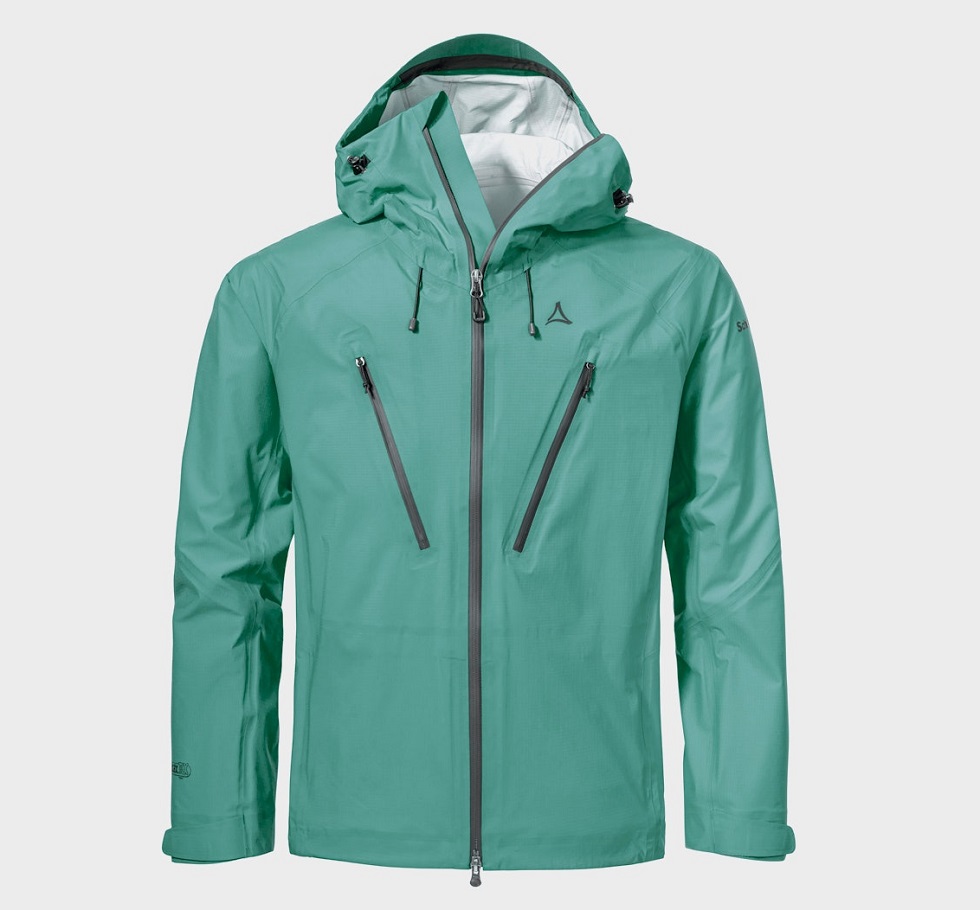
Dermizax, made by Toray, uses a non-porous polyurethane membrane rather than a microporous structure. Instead of pores, it relies on the molecular affinity of polyurethane for water vapour: moisture is absorbed on one side and released on the other through a chemical process rather than a physical one. The result is a membrane that is genuinely waterproof (no pores means nothing can physically penetrate it) and breathes well in high-output conditions. It also has a notably softer, quieter handfeel than ePTFE products, less crinkle, more drape. Dermizax NX, the current generation, is used by a number of premium ski and outdoor brands and has a strong reputation for durability. It is not a household name. It probably should be.
Futurelight
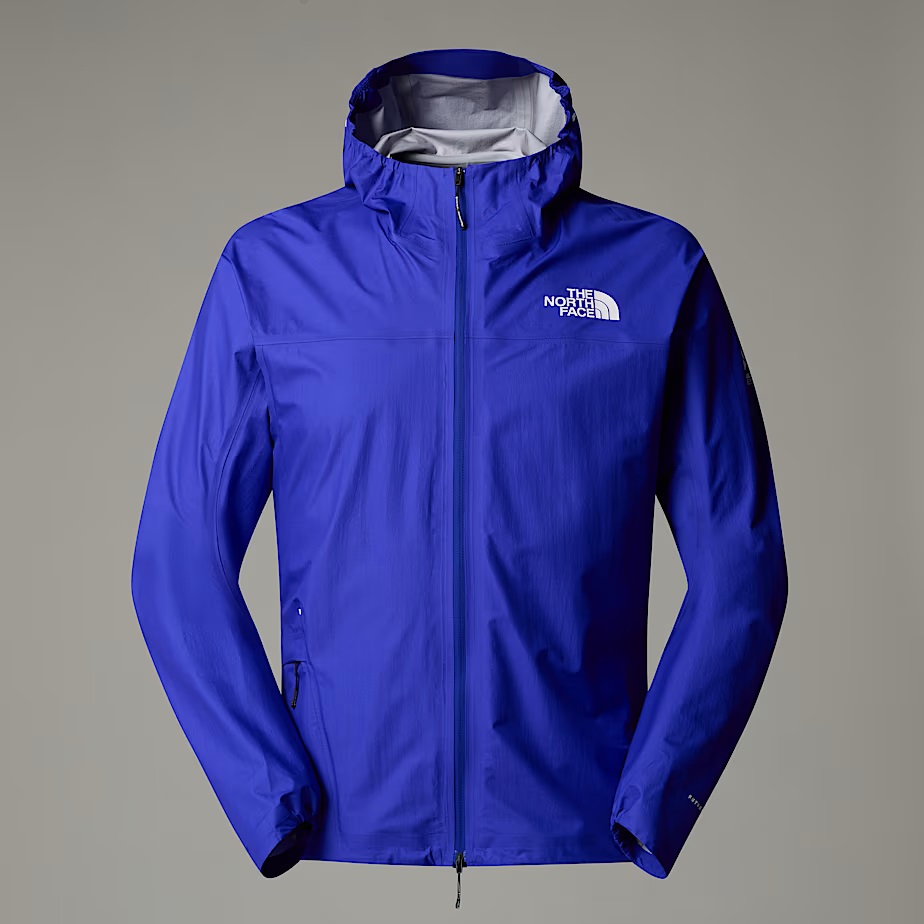
Futurelight, The North Face’s proprietary membrane launched in 2019, uses a nanospinning process to create an ePTFE-like structure with high air permeability. Early reviews were enthusiastic, particularly on breathability. Subsequent real-world experience has been more mixed, with some users reporting durability concerns and delamination in older garments. It remains a work in progress, which is perhaps the honest state of most membrane technology.
Pertex Shield
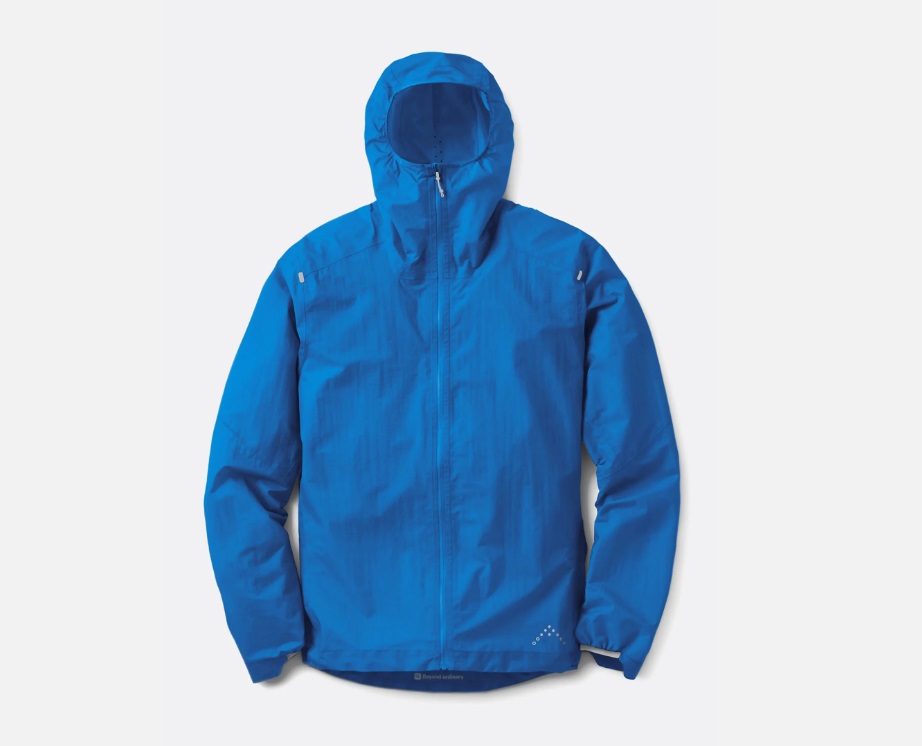
Pertex Shield occupies a different part of the market entirely: lighter, less bombproof, and significantly cheaper than the premium options. A 2.5-layer construction that prioritizes packability and weight over absolute performance, it is entirely adequate for urban use, travel, and moderate mountain conditions. It is not designed for serious alpine use, and it doesn’t pretend to be.
So is there a shining light?
The answer depends on what you’re asking.
For raw breathability in wet conditions, eVent has the most credible claim. Its direct-venting architecture genuinely addresses the humidity-differential problem more effectively than Gore-Tex’s standard approach. For comfort and handfeel in high-output use, Neoshell is in a category of its own, provided you accept its waterproofing limitations. For quiet, durable, softly draping performance across skiing and mountain travel, Dermizax NX deserves far more attention than it gets.
What none of them can do is fully escape the underlying physics. When the world outside is as wet as the world inside, breathability is constrained. That is not a failure of engineering. It is a fact of thermodynamics. The right tool for the right conditions has always been the honest answer. We have simply spent fifty years and considerable marketing budget pretending otherwise.
The Future Is Plural
There is no single next Gore-Tex. Instead, there is a spread of different answers for different questions, which is, if you think about it, exactly where the story started.
For the people who actually need it, Gore-Tex and its peers are not going anywhere. If you are standing in horizontal rain on a Scottish ridge or belaying a pitch in the Alaska Range, the calculus has not changed. You need a membrane, taped seams, and a hood that actually works. The technical shell is not in crisis. It is just no longer pretending to be something it isn’t.
For the people who want performance without the aesthetic, the alternatives have never been better. Non-Gore membranes tuned for comfort and drape. Two-layer shells that are lighter, quieter, and cheaper. Softshells with high water resistance that prioritize movement over absolute waterproofness. The idea that “good enough” waterproofing with genuinely better comfort might be the right answer for most people, most of the time, is finally getting the hearing it deserves.
For the people who want their jacket to look like clothing, the old answers are new again. Ventile is being rediscovered by niche outdoor brands and fashion labels who want performance that looks matte and moves like fabric. Waxed cotton is leaning into its patina, its smell, its frank acknowledgment that it is a material with a history. Burberry gabardine, Loro Piana’s Storm System, densely woven wools with hidden membranes: the idea that a waterproof jacket should look like a waterproof jacket rather than a piece of technical equipment is finding its audience.
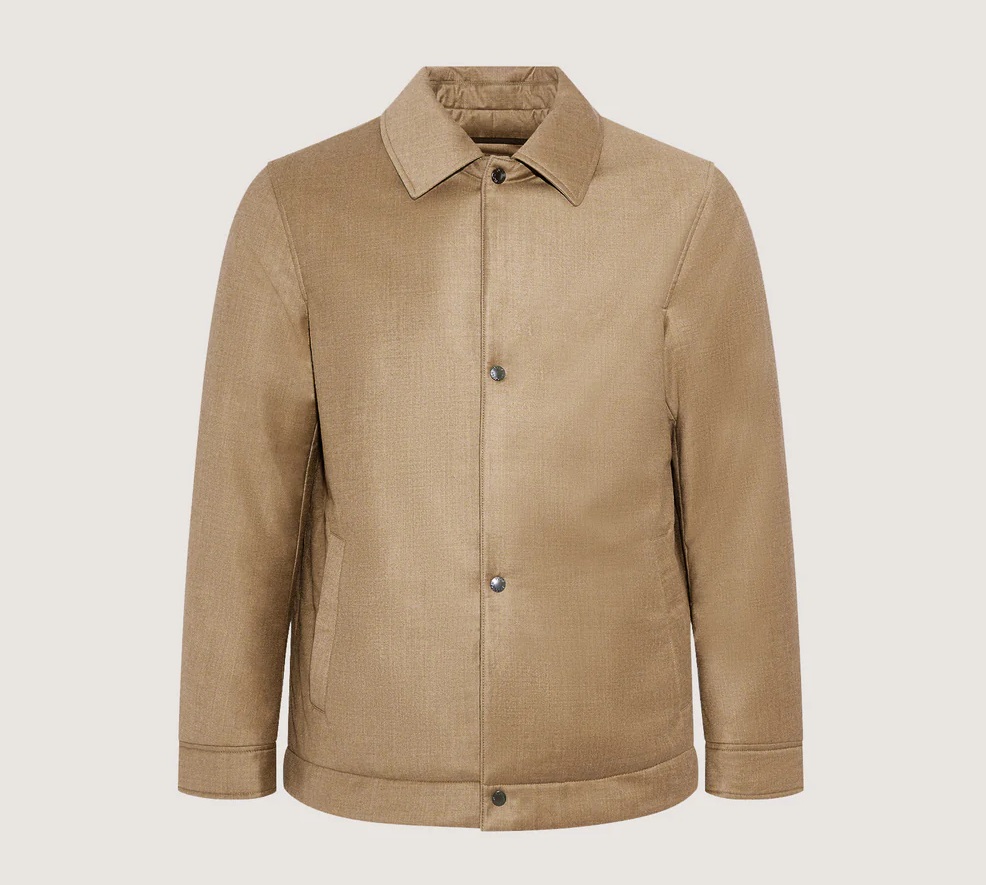
And then there are the hybrids, the jackets that are starting to ask whether the whole category needs rethinking. Waterproof membrane on the shoulders and hood, wool or softshell everywhere else. Denim with hidden stretch and water resistance. Shells designed to layer cleanly over knitwear rather than replace it. More a system of pieces that work together and look, individually, like clothes.
What the Gut Parka Knew
Look at the full arc of this story and something becomes clear.
The Aleut makers who sewed sea lion intestines into hooded anoraks were not working toward Gore-Tex. They were working toward the same thing Gore-Tex was working toward: a membrane that blocked liquid water while letting vapour through, light enough to wear, durable enough to trust your life to. They got there first, and in some respects, better than anything that followed for the next several centuries.
The history of the waterproof jacket is not a straight line from primitive to sophisticated. It is a series of different answers to the same question, each shaped by the materials available, the problems being solved, and the culture doing the solving. Rubber. Oil. Cotton so tightly woven it seals itself. A polymer stretched until it became a membrane. And before all of them: an intestine, a needle, and a knowledge of the sea that took generations to accumulate.
The perfect waterproof jacket still doesn’t exist. It probably never will, because “perfect” depends entirely on what you’re doing, where you’re doing it, and what you’re willing to carry, spend, and leave behind.
But the search has produced some extraordinary things. And it is far from over.
The Aleut gut parka tradition is documented by the Smithsonian Arctic Studies Center. Ventile fabric is still produced by Talbot Weaving in the UK. eVent, Neoshell, Dermizax, and Pertex Shield are available across a range of brands at varying price points.
