

So we asked a volcanic meister what life is like there.
From far away, the apartment building didn’t look abandoned, but as I hiked closer, I noticed open windows from which nature peeked through and subtle bits of damage on the concrete façade. According to my guide, Rie Egawa, a volcano meister—a trained and certified local expert at the Toya-Usu UNESCO Global Geopark in Hokkaido, Japan—the apartment building was struck by a bridge carried by a mudslide after the Mt. Usu volcanic eruption in 2000.
The building, along with a hot spring house and the bridge that hit it, remains standing in Japan’s first geopark, Toya-Usu UNESCO Global Geopark, as a reminder that volcanoes are a central part of life for those who live in the region.
Hokkaido is the second-largest island in Japan, home to 111 active volcanoes, including Mt. Usu, which formed about 20,000 years ago. During the 1910 eruption, it became “the birthplace of modern volcanic prediction” when, for the first time in the world, the active eruption was monitored by a seismometer near the crater.
For thousands of years, people have lived near Mt. Usu, and despite the threat of eruption, they continue to do so today. Egawa moved to the area in 1986 and witnessed the 2000 eruption from in front of her workplace.
“For three days prior, we had felt earthquakes, and the news had already reported that an eruption was likely, so I was mentally prepared. The earthquakes themselves were very frightening. I felt as if my house might collapse. Strong earthquakes (around seismic intensity 5+) continued for three days,” she recalls.
Continue Reading Article After Our Video
Recommended Fodor’s Video
Her home was not in the evacuation zone, but she saw a “thin layer of volcanic ash covering the roads and cars.” Although no injuries or deaths occurred, up to 15,815 people were subjected to evacuation orders. Those who lived in the Nishiyama and Konpira areas were affected the most, either losing their homes, having to relocate, or living in temporary housing.
“When I saw the eruption, I felt more awe than fear. I was not living very close to the crater. Looking back, I think I did not fully grasp it as something that could directly affect me,” Egawa says. “I watched the news and thought, ‘This feels like something from a movie. I wonder if people nearby are okay.’ I was thinking of it as someone else’s problem. This realization later became one of my motivations for becoming a volcanic meister.”

In 2008, the Hokkaido Government created certified volcanic meisters. They are designated as the “storytellers of volcanic legacies,” guides on volcano tours, and instructors for volcanic field studies. In the event of another eruption, the city looks to volcanic meisters for guidance. If they evacuate, others do too. They may also support evacuation shelters and “act as a bridge between authorities, scientists, and residents by communicating accurate information clearly,” explains Egawa.
Her journey to becoming a volcanic meister began when Egawa first moved to the area and visited the coast of Usu. The islands in the sea reminded her of the Seto Inland Sea where she was born.
“Later, I learned that this landscape was formed by a collapse of Mt. Usu about 8,000 years ago. That made me deeply interested in Mt. Usu,” she says. “Around that time, I learned about the volcanic meister program. While I was hesitating to apply, I met Saburo Mimatsu, a volcanic meister and the owner of Showa Shinzan. Meeting him led me to decide to become a volcanic meister [in 2015].”
Saburo Mimatsu was the husband of the granddaughter of Misao Mimatsu, a postmaster who sold his assets to purchase Mt. Showa Shinzan, a volcanic lava dome, in 1945. Mt. Showa Shinzan sits in front of Mt. Usu and formed alarmingly fast after the 1943-1945 Mt. Usu eruption. Mimatsu kept records of the formation of Mt. Showa Shinzan, and his research and observations contributed greatly to volcano research.
Egawa respected the elder Mimatsu’s work for volcanic disaster prevention, saying, “He never treated volcanoes as enemies and faced nature with sincerity.”
This mindset is one that Egawa and many of the locals seem to have towards volcanoes.
“Living close to a volcano does involve risk, but Japan is a country prone to natural disasters, so risks exist everywhere. I believe people in this region have the determination to continue living here,” she says.
Twenty-six years have passed since Mt. Usu erupted. It’s estimated that Mt. Usu erupts every 20 to 50 years, so the next eruption could occur at any time.
“It could be tomorrow, or it could be 20 years from now,” explains Egawa. “What we can do is to be prepared so that we can protect our lives whenever it happens.”
To stay prepared, the region hosts seminars, disaster drills, public awareness activities, and has constructed sabo dams and installed vegetation on the volcano to control mudflows that may occur. “Many monitoring instruments have been installed by institutions such as the Japan Meteorological Agency and Hokkaido University,” says Egawa.
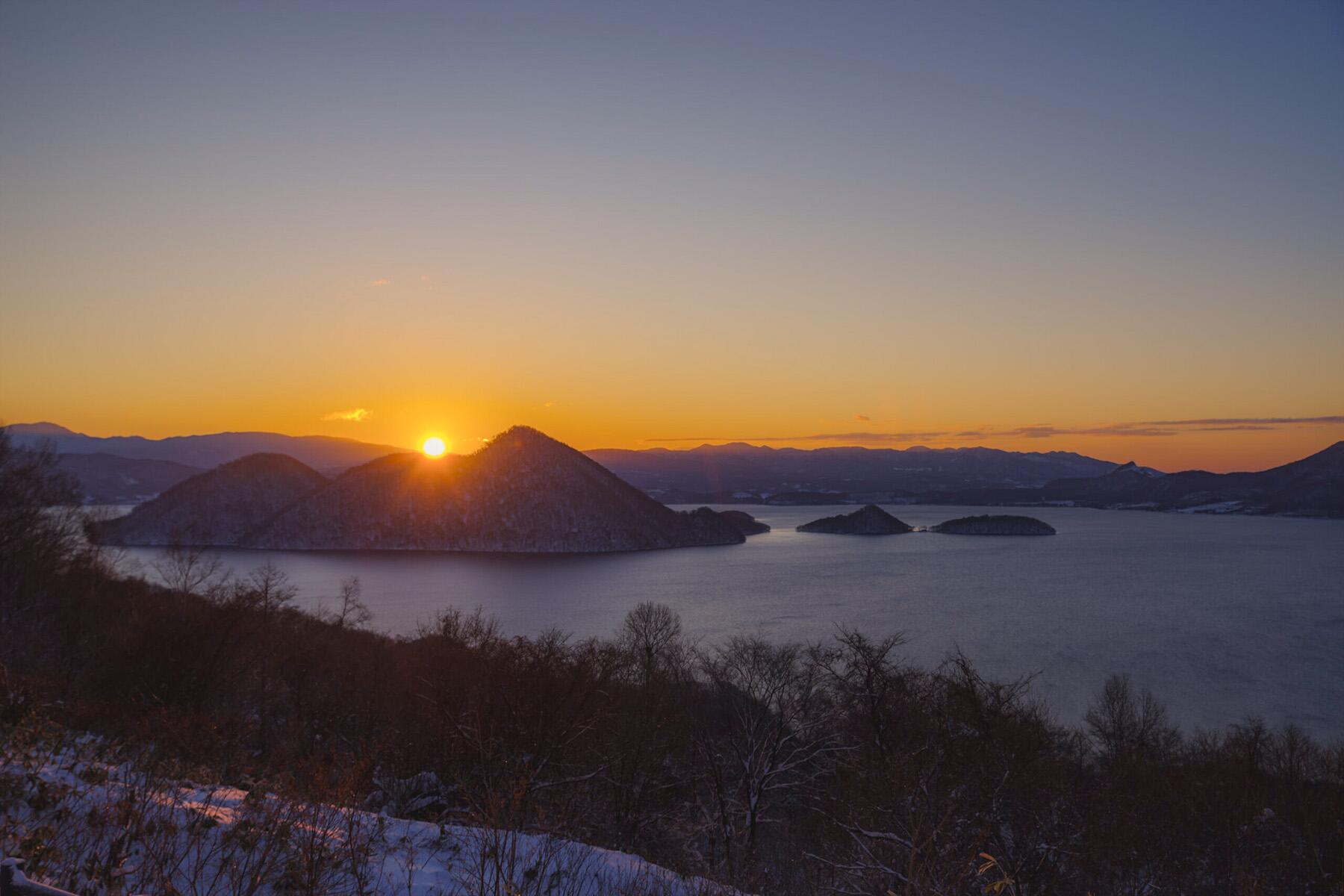
Living near a volcano provides a unique lifestyle, one that travelers learn about in numerous ways. Tourists visit the region to soak in the natural hot springs that are a product of the active volcano. Others take the Usuzan Ropeway up Mt. Usu to enjoy panoramic views of Lake Toya and the surrounding areas, which were formed by the volcano over thousands of years. Multiple museums, like the Mimatsu Masao Memorial Museum, the Volcano Science Museum, and the Sobetsu Information Center, share educational information and videos about the volcano. Although you can take your own hikes on designated trails around Mt. Usu, I participated in one of Egawa’s tours, where she guided my group to two volcanic craters—something that only a volcanic meister can do with special permission.
“By learning about Mt. Usu and the lives of people here, I hope they will see disasters as something personal and be inspired to prepare and protect their own lives when they return home,” she explains. “Second, I want them to understand that nature has two sides. For example, hot springs can heal people, but they can also become the source of destructive mudflows.”
When the next eruption occurs, the landscape around Mt. Usu is likely to change.
“If I think only about the natural process, I feel excitement. However, considering the disasters that may accompany it, I cannot simply welcome it,” says Egawa. “Since the birth of the Earth, life, and humanity, the land has always been changing. As part of nature, we must accept this.”
Those who have never lived near a volcano may be surprised by Egawa’s perspective and question why people remain in the area. Egawa understands the fear and hesitation, but she is reminded of the words of volcanic meister, Saburo Mimatsu: “If you want to avoid disasters, would you live on the moon? There is no water or oxygen there. Life can only exist on Earth. So, we must understand its nature, receive its blessings in peaceful times, and prepare to survive anywhere. Humans cannot resist nature.”
