

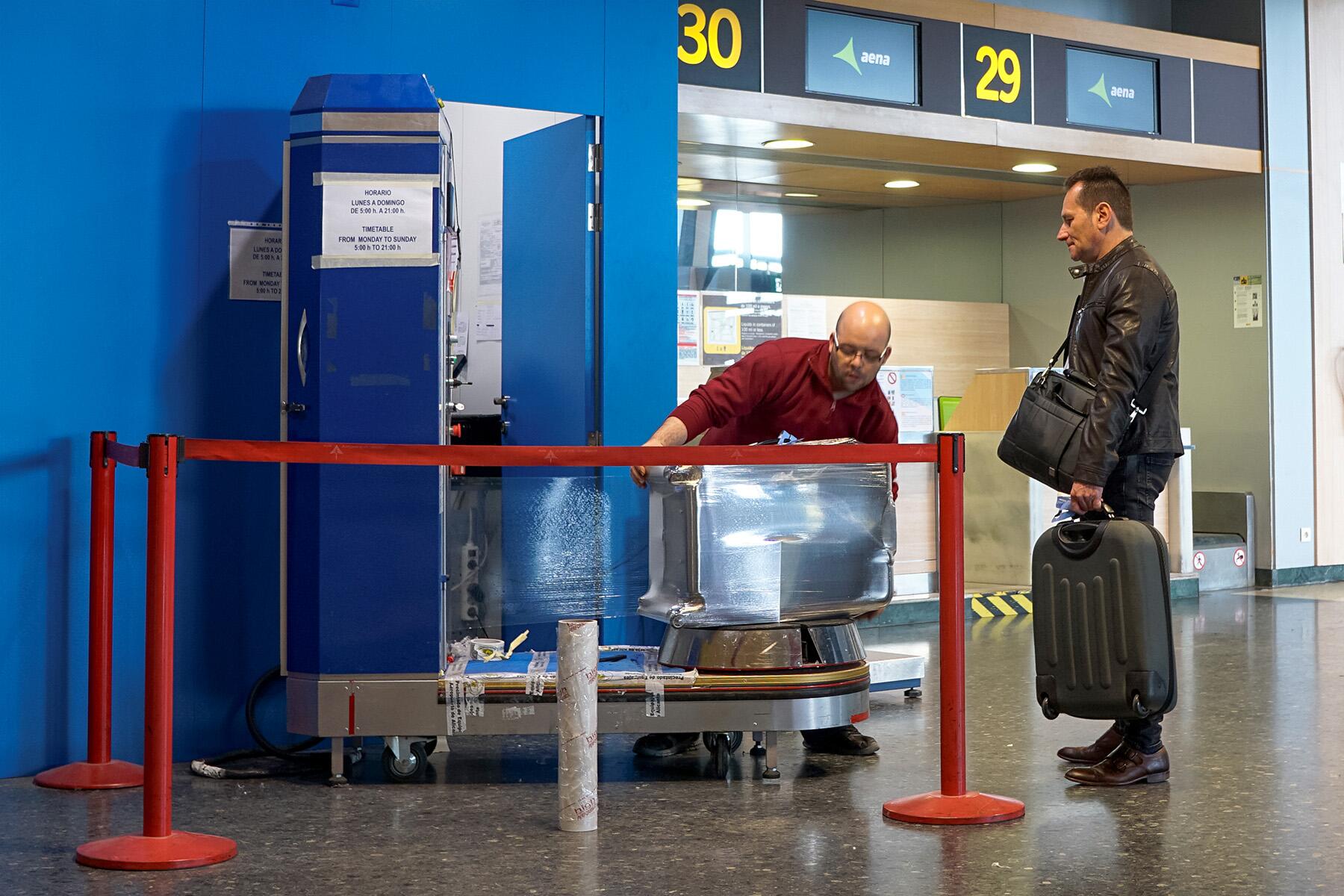
This widely seen airport ritual isn’t just about protecting your belongings—it’s about managing uncertainty in one of travel’s most stressful moments.
We’ve all come across them at airports: those pre-security kiosks where you can quickly get your suitcases wrapped in yards of brightly-colored cellophane. Depending on your perspective, you may roll your eyes and tell yourself how the practice is a complete waste of money, or pull out your credit card and get in line, eager to safeguard your belongings with a few millimeters of plastic.
Either way, you may also be curious about why this quirky travel ritual not only endures, but thrives, especially in certain regions. Why exactly are passengers still shelling out for this service? And perhaps more interestingly, how can it be viewed as a commentary on the psychology of travel?
What Shrink-Wrapping Can (and Can’t) Actually Do
While it’s still a head-scratcher for many U.S. travelers, shrink-wrapping suitcases is commonplace in airports across South Africa, Latin America, and parts of Europe. There are some practical considerations why fliers might consider it, according to Georgene Rada, vice-president of luggage manufacturer Briggs & Riley.
“Shrink-wrapping primarily protects from moisture and dirt,” Rada explains. That includes places prone to inclement weather, such as thunderstorms and typhoons, where baggage may linger on the tarmac before being loaded or unloaded. “It could also prevent some abrasion, but it’s not going to prevent damage from significant impact.” Fabric-based suitcases are less apt to be scratched or dinged than their hard-sided counterparts, and if you’re really worried about damage to the bag itself, luggage manufacturers, including Briggs & Riley, sell covers designed to fit your model of bag.
Continue Reading Article After Our Video
Recommended Fodor’s Video
Steven Vigor, travel advisor and CEO of Revigorate, a luxury travel concierge and bespoke trip-planning company, points out that shrink-wrapping is also used as a theft deterrent.
“In places like South Africa or Latin America, your chances of tampered-with luggage rise significantly,” adds Vigor. “While it won’t stop a determined thief, it makes a quick grab-and-run much less appealing due to added complications.” Given the option of a lock that can easily be picked in a few seconds or a bag that requires the use of a box cutter and a fair amount of time, an opportunist will most likely prefer to pilfer the former.
When Mariana Anchante, senior manager of public relations for Jive PR + Digital, lived in Lima, Peru, the shrink-wrapping station was always her first stop at the airport, especially as the proud owner of white luggage. She also recalls a trip to Panama when items were stolen from her luggage, and the airlines wouldn’t accept responsibility.
“The counter representative even said they often receive similar complaints, which increased my fear of traveling with completely unprotected luggage,” Anchante says.
But the perceived and actual benefits of shrink-wrapping also come with an environmental tradeoff: shrink-wrapping typically involves layers of single-use plastic that are removed and thrown away as soon as you land.
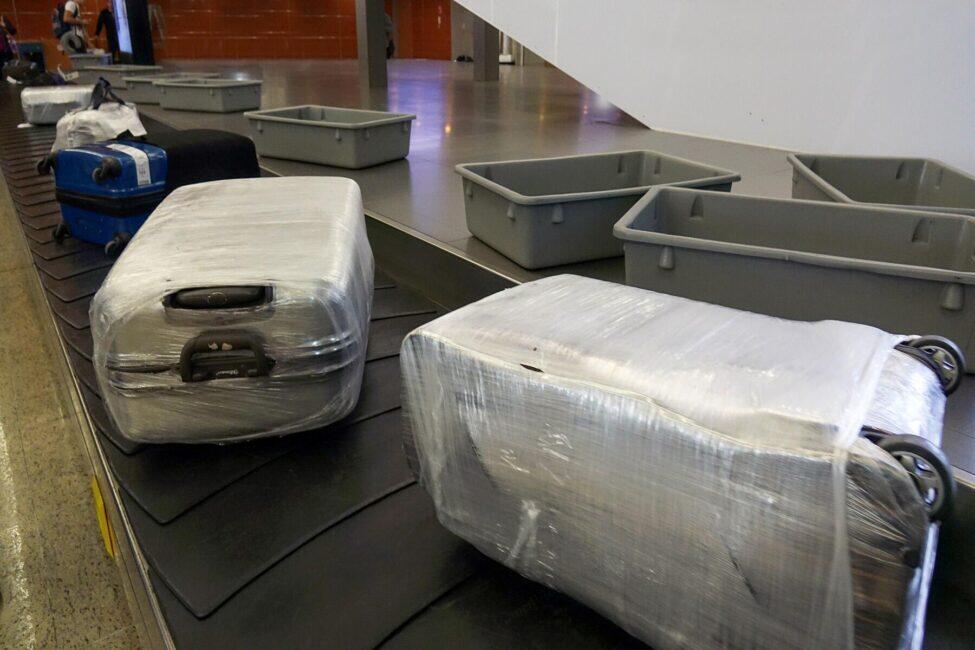
Does Shrink-Wrapping Your Luggage Make You a Target for Additional Screening?
Though it may seem like wrapping your bags is just asking for them to be opened and rechecked, it doesn’t raise red flags with security or make you more susceptible to advanced or secondary screenings, according to a Transportation Security Administration (TSA) spokesperson.
“Wrapped bags aren’t more likely to require manual inspection or additional screening than unwrapped bags,” the TSA spokesperson said. “Each bag is evaluated individually using different methods such as x-ray screening, K9 inspection, physical search, and explosive trace detection, and the decision to open a bag is based on the results of these evaluations.”
However, while agents will generally reapply your nylon strap or fabric covering after inspection, they won’t replace disposable plastic wrap. Some airport-based wrapping services, including Secure Wrap, will rewrap any item that’s been opened for additional screening free of charge.
What About the Psychology Behind the Plastic?
Though there are potential benefits to shrink-wrapping your luggage, the risk of theft or damage is relatively low compared with the number of pieces of baggage handled each day. So, what’s really behind this persistent practice? According to psychologists, it comes down to the principle of the “illusion of control.” When people feel out of control in a situation, they’ll engage in behaviors designed to compensate, regardless of whether they actually alter the outcome.
“Passengers continually remind themselves of how vulnerable they are: they relinquish custody of their luggage; they undergo security screening, and they rely on numerous other third parties,” explains Monica Clayborn, MS, licensed professional counselor and vice-president of quality and outcomes at BasePoint Breakthrough, a mental health treatment provider focused on therapy and behavioral care. After we leave our luggage at the airline counter, it’s out of our sight for hours or more, with minimal feedback on its whereabouts or status beyond our luggage receipt or maybe a tracking text.
But shrink-wrapping translates abstract risk into something tangible and observable. “There is tactile feedback, the bag feels sealed, and the barrier is easy to see,” says Hannah Lewis, the counselor and psychotherapist for Compare My Health Insurance. The limited personal influence we have in airline travel, coupled with layers of procedures, tight timelines, and putting our faith in the hands of strangers, from pilots to baggage handlers, makes the illusion of control compelling.
“When outcomes are opaque, small actions that offer immediate, visible reassurance, like shrink-wrapping, can feel disproportionately meaningful.” Lewis likens it to other practices like cable-tying zippers, photographing luggage at check-in, and vigorously wiping down airplane seats and tray tables, whose emotional impact often outweighs any actual risk.
Security, Habit, or Peace of Mind? Why Has the Trend Persisted?
For all the debate over whether it actually works, shrink-wrapping is still popular for a simpler reason: it makes travelers feel better. Flying can be frenetic and fraught with stress, and fliers are forced to let go of many of the details during the journey; shrink-wrapping can help offset that vulnerability and diminished feeling of control.
“People usually react to how scary a certain risk appears to them, not necessarily how probable it really is,” believes Claire Law, a psychologist and legal contributor at Custody X Change, a co-parenting and child custody planning software company. Shrink-wrapping is a rational strategy to make an uncertain environment more predictable. It’s endured, she says, because if your luggage makes it to baggage claim unscathed, there’s no way of actually knowing if the covering had anything to do with it.
In other words, whether or not it truly protects your bag, the simple act of wrapping it offers something just as valuable: peace of mind.
